
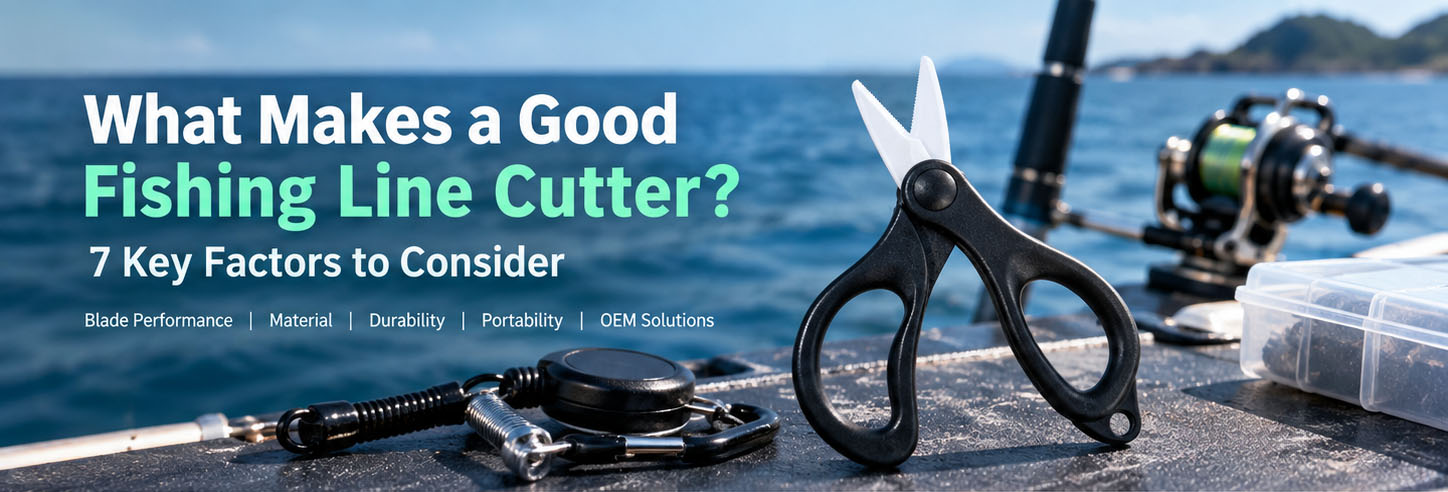
A fishing line cutter may be one of the smallest tools in a tackle box, but it can make a noticeable difference during a day on the water. Whether you are trimming a braided PE line, cutting a fluorocarbon leader, or removing the tag end of a monofilament knot, you want a clean cut without having to squeeze the handles several times or reposition the line repeatedly.
However, choosing a good fishing line cutter involves more than looking for a sharp blade. The blade material, edge geometry, cutting consistency, corrosion resistance, handle design, and portability all affect how well a cutter performs in real fishing conditions.
These details also matter to fishing tackle brands, distributors, wholesalers, and private-label sellers. A product that works well during a single demonstration may not necessarily deliver consistent results across different fishing lines or throughout repeated use. For commercial buyers, product specifications, sample testing, manufacturing consistency, and customization options deserve just as much attention as the initial cutting performance.
So, what actually makes a good fishing line cutter? The answer depends on the lines you use, the environment in which you fish, and what you expect from the tool. This guide explains the key features to evaluate before choosing a fishing line cutter for personal use or adding one to your product range.
What Makes a Good Fishing Line Cutter?
A good fishing line cutter should cut the intended fishing line cleanly, remain comfortable to use, and hold up under the conditions for which it was designed. No single feature guarantees a good result. Blade sharpness, edge geometry, material selection, and the alignment of the cutting edges all work together.
Clean and Consistent Cutting Performance
The first thing to evaluate is whether the cutter can sever the fishing line cleanly without excessive pressure or repeated attempts. This is especially important when trimming a short tag end, where there may be very little line available to reposition.
A clean cut can make knot finishing easier and reduce the frustration of dealing with loose braid fibers or an incompletely severed line. Performance should also remain reasonably consistent across repeated cuts, rather than depending on one successful attempt.
Blade Design That Matches the Fishing Line
Different fishing lines behave differently when they come into contact with a cutting edge. Braided PE line consists of multiple fibers, while monofilament and fluorocarbon are single-filament lines with different material properties and degrees of stiffness.
A blade designed to engage braided fibers may not be the ideal choice for every other application. The blade angle, edge finish, cutting-edge alignment, and overall scissor geometry all influence the result.
Corrosion Resistance and Long-Term Reliability
Fishing tools are often exposed to moisture, salt spray, wet hands, and damp tackle storage. A cutter intended for saltwater fishing needs to be evaluated for corrosion resistance, including the pivot, screws, springs, and other metal components rather than just the blade.
Durability also includes the ability to maintain useful cutting performance with regular use. A cutter that performs well when new but quickly becomes difficult to use may not be a good long-term choice.
Comfort, Safety, and Portability
A practical fishing line cutter should be easy to grip, control, store, and retrieve. Compact dimensions are useful, but a small tool is not automatically convenient if it is difficult to handle with wet fingers or hard to locate inside a tackle bag.
For many anglers, a protective design, a secure attachment point, or a retractable tether can be just as useful as a particular blade material.
1. Blade Sharpness Matters, but It Is Not Everything
Sharpness is one of the first things people consider when buying fishing scissors. It matters, of course, but it does not tell the whole story. A sharp edge can still produce an unsatisfactory cut if the line slips away from it, the blades do not meet properly, or the cutting geometry is unsuitable for the line being used.
Why Can a Fishing Line Slip Instead of Being Cut?
Fishing line is flexible, and some types are particularly difficult to hold in a fixed position during cutting. Braided PE line can move or flatten under pressure because it is made from multiple interwoven fibers. Smooth monofilament and fluorocarbon can also shift along the cutting edge, especially when the line is not positioned securely.
This is why blade contact matters. The cutting edges must engage the line rather than simply press against it. With scissors, the alignment between the two blades is particularly important. Poor alignment can leave a gap through which fine line escapes instead of being severed.
When evaluating a cutter, pay attention to how easily the line stays in place, whether the cut is completed in one controlled movement, and how much pressure is needed. These observations are often more useful than judging sharpness by appearance alone.
Edge Retention and Repeated Use
A new cutter may perform well during the first few cuts. The more important question is whether it continues to perform reliably after repeated use.
Edge retention depends on the blade material, manufacturing process, edge geometry, the lines being cut, and the way the tool is handled. Dirt, abrasive particles, improper use, and accidental contact with hard materials can also affect cutting performance.
For fishing tackle brands, this distinction matters when evaluating a potential product. A sample should not be judged solely on its first cut. Repeated cutting tests across the intended line types provide a more useful picture of whether the product is suitable for its target market.
Why Consistency Matters to Product Brands
Commercial buyers need to think beyond an individual user's experience. If a product is sold under a private label, customers expect the units they receive to perform consistently with the product they saw in a demonstration or tested as a sample.
It is worth asking how blade alignment, assembly, and finished-product inspection are controlled during manufacturing. A clear product specification and an agreed sample are useful starting points for discussing quality expectations with a supplier.
2. Choose the Right Blade Edge for Different Fishing Lines
One of the most useful ways to evaluate a fishing line cutter is to consider the actual lines it needs to cut. A tool designed for occasional monofilament trimming may not be the best fit for an angler who frequently cuts braided PE line. Similarly, a product intended for general freshwater use may need additional evaluation before being positioned for saltwater applications.
Braided PE Line: Grip and Fiber Engagement
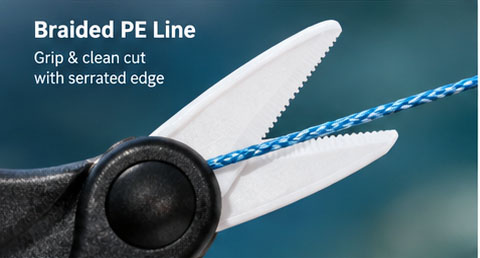
Braided fishing line is made from multiple fibers woven together. Its flexibility and construction can make clean cutting challenging when the blade cannot engage the fibers effectively.
Some fishing scissors use a serrated edge to help engage braided fibers during cutting. The small teeth can provide additional points of contact, helping the blade grip the braid instead of allowing it to slide freely along a smooth edge. However, serration design, tooth spacing, blade alignment, and manufacturing quality all influence the final result.
Line construction is another consideration. Eight-strand and twelve-strand braids can differ in surface texture, roundness, and flexibility. There is no reason to assume that every cutter will perform identically on every braid simply because both products are marketed for PE line.
If braided line is the primary application, test the cutter on the actual braid sizes and constructions your customers use. Observe whether the cut is clean, whether loose fibers remain, and whether the tool continues to perform consistently over repeated attempts.
For a closer look at this subject, see our guide to how serrated edges improve braided-line cutting.
Fluorocarbon: Controlled Cutting of a Smooth, Stiffer Line
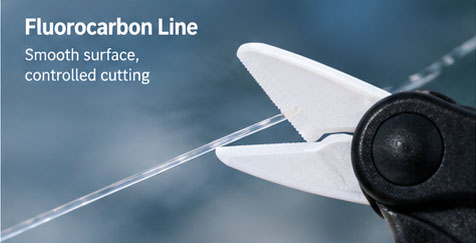
Fluorocarbon leaders are widely used in fishing applications where abrasion resistance, underwater visibility, and leader properties are important. When cutting fluorocarbon, the line's stiffness and smooth surface can make secure positioning important.
A suitable cutter should engage the line cleanly without requiring excessive force. Blade alignment, the opening and closing action of the scissors, and the intended line diameter all affect the result.
It is also important to distinguish between cutting a line and cutting a knot. A cutter that trims a straight section of fluorocarbon successfully may behave differently when working close to a bulky knot or when access is restricted. Buyers should evaluate the intended use rather than relying on a general claim that a tool can cut fluorocarbon.
Learn more in our article, Can Ceramic Scissors Cut Fluorocarbon Fishing Line?
Monofilament: Precision for Fine Line and Tag Ends
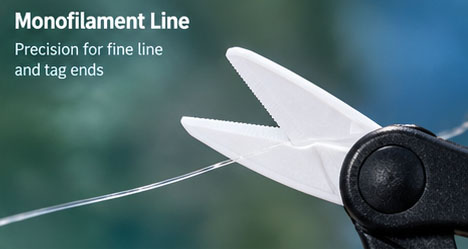
Monofilament fishing line is a single filament rather than a bundle of woven fibers. Fine monofilament can be difficult to position accurately, particularly when only a short tag end needs to be removed.
For this application, a well-aligned cutting edge and controlled scissor action are valuable. The tool should be able to reach the line without forcing the angler to make several adjustments, while allowing the user to trim close to the knot when needed.
As with other line types, the result depends on the cutter's design and the line diameter. A good product evaluation should include the range of monofilament sizes specified for the tool, rather than testing only one convenient sample.
For more detail, read our guide to ceramic scissors for monofilament fishing line.
Can One Fishing Line Cutter Handle All Three?
Yes, a suitably designed cutter may handle braided PE, monofilament, and fluorocarbon line. However, the term "multi-purpose" should be supported by actual testing and clearly defined application limits.
| Fishing line | Common cutting concern | What to evaluate |
|---|---|---|
| Braided PE | Fiber movement and fraying | Edge engagement, serration, and cutting consistency |
| Fluorocarbon | Smooth surface and line stiffness | Secure contact, blade alignment, and cutting control |
| Monofilament | Fine-line positioning and tag-end trimming | Edge sharpness, precision, and ease of handling |
For anglers, the best approach is to match the cutter to the lines used most often. For distributors and fishing tackle brands, a multi-line product may offer broader market appeal, provided its performance is verified across the intended applications.
3. Ceramic vs. Stainless Steel: Which Blade Material Should You Choose?
Blade material is another important consideration when selecting fishing scissors. Zirconia ceramic and stainless steel offer different material characteristics, and neither should be evaluated in isolation from the finished tool's design and manufacturing quality.
What Zirconia Ceramic Offers
Zirconia ceramic is a hard engineering material used in a variety of cutting and wear-related applications. In fishing scissors, its potential advantages include high hardness, wear resistance, and resistance to the ordinary rusting associated with steel blades.
These characteristics make ceramic blades worth considering for fishing tools that may be exposed to moisture or saltwater. A ceramic blade also offers a material distinction that can be relevant to fishing tackle brands looking to develop a product range with a clear point of difference.
However, high hardness does not mean that a ceramic blade is indestructible. Ceramic materials can be more susceptible to chipping or fracture under certain impact or bending conditions than many metal alternatives. The blade geometry, product construction, and intended handling conditions therefore remain important.
Cutting performance still depends on edge design and manufacturing precision. A ceramic blade should be evaluated on the same practical criteria as any other cutter: clean cuts, consistent results, suitability for the intended line types, and durability under realistic use.
Where Stainless Steel Still Makes Sense
Stainless steel remains a practical choice for many fishing tools. Its performance depends on the specific alloy, heat treatment, blade geometry, and surface condition. Different stainless steels have different levels of hardness, toughness, and corrosion resistance.
Some steel designs may offer useful resistance to impact or rough handling. Others may be selected for edge retention, manufacturing requirements, or overall product cost. Stainless steel should not be treated as one uniform material, just as ceramic products should not all be assumed to have identical performance.
For saltwater use, buyers should confirm the steel grade and evaluate the complete tool. Stainless steel is corrosion-resistant rather than universally corrosion-proof, and maintenance remains important.
Compare the Complete Tool, Not Just the Blade
| Evaluation factor | Zirconia ceramic | Stainless steel |
|---|---|---|
| Blade corrosion | The ceramic blade itself does not rust like steel | Depends on the alloy and surface condition |
| Hardness and wear | High hardness and wear resistance | Depends on the steel grade and treatment |
| Impact behavior | May chip or fracture under unsuitable impact loads | Many designs offer useful toughness, depending on the alloy |
| Cutting performance | Depends on edge geometry, alignment, and manufacturing | Depends on edge geometry, alignment, and manufacturing |
| Whole-tool corrosion resistance | Metal pivots, screws, and other components still require evaluation | Blade and other metal components require evaluation |
The practical question is not simply which material sounds better. It is which finished product meets the customer's needs at an appropriate price and with acceptable performance over its expected service life.
For a more focused comparison, see Ceramic vs. Stainless Steel for Fluorocarbon Line Cutting.
4. Corrosion Resistance Is Essential for Saltwater Fishing
Saltwater fishing creates additional demands on tools. Salt deposits can remain on surfaces after water evaporates, while moisture trapped in a tackle bag or around a pivot can prolong exposure to corrosive conditions.
A ceramic blade can avoid the ordinary rusting associated with a steel blade, but that advantage should not be confused with complete immunity to corrosion across the entire cutter. Most compact fishing scissors contain several components, and the materials used for those components also matter.
What Should Saltwater Anglers Check?
Blade material: Confirm whether the blade is ceramic, stainless steel, or another material.
Pivot and fasteners: Check the exposed metal components that allow the scissors to open and close.
Storage and drainage: Consider whether the tool can be cleaned and dried without difficulty.
Maintenance instructions: Follow the manufacturer's guidance for rinsing, drying, and storage.
Application claims: Look for evidence that the complete product is suitable for the intended environment.
For distributors and private-label buyers, these details can help prevent a mismatch between the product's intended use and its marketing claims. If a cutter is positioned for saltwater anglers, its description should account for the entire tool, not just the blade.
5. Ergonomics, Portability, and Safety Matter on the Water
Even a well-made blade can be frustrating to use if the scissors are difficult to grip or inconvenient to carry. Fishing often involves wet hands, limited working space, and the need to make quick adjustments without putting down other equipment.
A Comfortable Grip for Repeated Cutting
Handle shape, opening size, finger clearance, and the force required to close the blades all influence comfort. A compact cutter should still allow the user to control the cutting position accurately.
Grip requirements vary from one user to another. Buyers should consider the intended audience and test whether the product can be operated comfortably during repeated trimming, including when the user's hands are damp.
Compact Design and Secure Attachment
A small cutter is easy to carry, but it can also be easy to misplace. Attachment features such as a clip, lanyard, or retractable tether can make the tool easier to retrieve and return to its storage position.
For example, MIDDIA's BXJ02 ceramic fishing line cutter is presented with a serrated ceramic blade and a retractable tether with a carabiner. This type of configuration is intended to make the cutter more convenient to keep within reach while fishing. Buyers should confirm the exact configuration and specifications for the model they plan to purchase.
See the MIDDIA ceramic braided fishing line cutter for product details.
Blade Protection and Safe Storage
Storage design deserves attention as well. A cutter should be easy to put away without exposing the blade unnecessarily or allowing the tool to move loosely around other equipment.
For ceramic-bladed products in particular, avoiding accidental impacts against hard objects is sensible because ceramic can chip or fracture under unsuitable loads. A protective storage solution and clear handling instructions can help users care for the tool properly.
6. How to Test a Fishing Line Cutter Before Buying
Product descriptions and photographs can help narrow the options, but a practical cutting test is one of the most useful ways to evaluate a fishing line cutter. The test should reflect how the tool will actually be used.
Test the Actual Fishing Lines You Use
Start with the intended line types: braided PE, monofilament, and fluorocarbon, where applicable. Use representative line diameters rather than assuming that a successful cut on a thin line proves suitability for every size.
For a fair comparison, use similar line lengths, consistent positioning, and the same basic cutting procedure for each candidate. Record the line type and diameter so the results can be interpreted later.
Check Cut Quality and Repeatability
During the test, observe whether the line is completely severed, whether the braid shows obvious fraying, and whether the cutter requires repeated squeezing or repositioning. Also note whether the line slips away from the cutting edges.
Repeat the test several times. A single clean cut is encouraging, but repeatability provides more useful evidence of practical performance. If a product is intended for multiple line types, test each one separately.
Evaluate Realistic Handling Conditions
Consider how the cutter behaves when retrieved from storage, held with damp hands, and used in a typical fishing position. For saltwater applications, review the manufacturer's care instructions and any available test evidence relevant to the complete tool.
Do not confuse a short cutting demonstration with a long-term durability test. If service life is an important purchasing criterion, it should be assessed through an appropriate repeated-use protocol and clearly defined acceptance criteria.
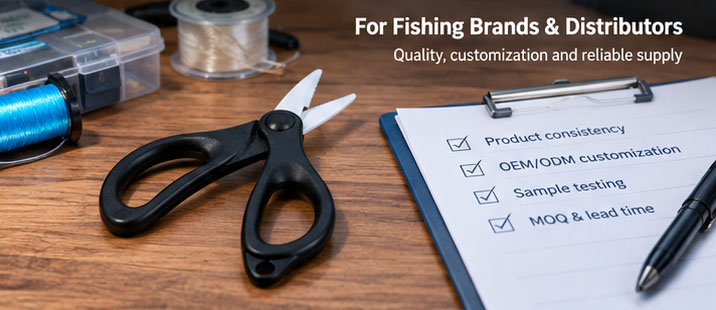
What Fishing Tackle Brands Should Request From a Supplier
For a brand or distributor, the evaluation process should extend beyond cutting performance. Before approving a product, consider requesting:
Samples that match the intended production specification.
Confirmation of blade material, product dimensions, and included accessories.
Information about inspection procedures and production consistency.
Clarification of supported line types and any application limitations.
Details of packaging, customization options, minimum order quantity, and lead time.
These questions help establish a clear basis for supplier comparison. They also reduce the risk of approving a sample without confirming whether the same specifications can be maintained in subsequent orders.
7. What Fishing Brands and Distributors Should Look for in a Supplier
For commercial buyers, selecting a fishing line cutter is only part of the decision. The supplier also needs to support the requirements of the intended market, sales channel, and product positioning.
Product Consistency and Manufacturing Capability
Ask how the supplier defines the product specification and checks finished units. Relevant details may include blade alignment, opening and closing action, handle finish, accessory installation, and packaging accuracy.
It is also useful to agree on what constitutes an acceptable sample before placing a production order. Written specifications and clear inspection criteria help both parties understand the expected result.
OEM and Private-Label Customization
Fishing tackle brands and private-label sellers may need more than an off-the-shelf product. Depending on the model and manufacturing arrangements, customization may include logo application, handle color, packaging, and selected product configurations.
Not every change is available for every model, and some requests may involve additional costs, tooling, or minimum order requirements. Buyers should confirm feasibility and obtain approval of the final artwork or sample before mass production.
For Amazon sellers and other online retailers, packaging and product presentation should match the actual product features. For distributors, a clear specification can make it easier to position the item within an existing fishing tackle range.
MOQ, Samples, and Lead Time
Before moving forward, confirm the minimum order quantity, sample availability, sample lead time, production lead time, and shipping requirements. These factors influence whether a product is suitable for a small initial launch or a larger distribution program.
It is also worth discussing how changes are handled after sample approval. A change in materials, accessories, color, or packaging can affect the final product, so the approved configuration should be documented.
Look Beyond Marketing Claims
Terms such as "ultra-sharp," "premium," and "long-lasting" are easy to put in a product description. They are less useful unless the supplier can explain what they mean for the specific product.
Instead of relying on general claims, ask for relevant specifications, samples, test methods, and quality-control information. If corrosion resistance, cutting consistency, or service life is central to the product positioning, define how that requirement will be evaluated.
For brands developing a ceramic fishing scissors range, MIDDIA provides a starting point for discussing product specifications and suitable OEM or private-label options. The right configuration should be selected according to the target market, intended fishing conditions, and results of sample evaluation.
8. Is a Ceramic Fishing Line Cutter Right for Your Product Line?
A ceramic fishing line cutter may be worth considering when blade corrosion resistance, hardness, wear resistance, and product differentiation are important to the intended application. It can also be relevant to brands that want to offer an alternative to conventional metal-bladed fishing scissors.
That does not mean every customer needs a ceramic cutter. The decision should reflect how the product will be used, the lines it must cut, the expected handling conditions, and the target selling price.
When Ceramic Fishing Scissors Are Worth Considering
Your customers regularly fish in wet or saltwater environments.
The product needs to handle specified PE, monofilament, or fluorocarbon lines.
Your brand wants to explore a cutting tool with a distinctive blade material.
You need a compact fishing accessory with practical carrying features.
You are developing a private-label product and want to compare material and configuration options.
Match the Product to Your Market
Freshwater anglers, saltwater anglers, braided-line specialists, and general fishing tackle customers may prioritize different features. A premium product range may place greater emphasis on materials and finish, while a high-volume accessory range may focus on practical performance, product consistency, and overall value.
For distributors and brands, the sensible approach is to define the target customer first, evaluate samples against the relevant requirements, and then confirm the commercial details with the supplier. This provides a more reliable basis for product selection than choosing by material claims alone.
Frequently Asked Questions
Q1. What Is the Most Important Feature of a Good Fishing Line Cutter?
Reliable cutting performance is the starting point. The cutter should cleanly sever the intended fishing line with controlled effort. Blade geometry, alignment, material, corrosion resistance, ergonomics, and portability all contribute to whether the tool is suitable for a particular user.
Q2. Are Ceramic Fishing Scissors Better Than Stainless Steel?
Not in every application. Zirconia ceramic offers high hardness, wear resistance, and resistance to the ordinary rusting associated with steel blades. Stainless steel offers a range of material properties depending on the alloy and treatment. The better choice depends on cutting requirements, impact resistance, maintenance, budget, and the design of the complete tool.
Q3. Can One Fishing Line Cutter Cut Braid, Mono, and Fluorocarbon?
A cutter designed and tested for multiple line types may handle all three. However, performance depends on the blade design, line diameter, and product construction. Check the manufacturer's stated applications and test the cutter on the actual lines you intend to use.
Q4. Are Serrated Fishing Scissors Better for Braided Line?
Serrations can help engage braided fibers and reduce unwanted movement along the cutting edge. Their effectiveness depends on the tooth design, blade alignment, and manufacturing quality. Smooth-edge designs can also perform well in suitable applications, so practical testing is the best way to compare products.
Q5. What Should I Look for When Buying Fishing Scissors in Bulk?
Evaluate sample performance, material specifications, product consistency, inspection procedures, minimum order quantity, lead time, packaging, and after-sales support. If you are buying for a brand or distribution business, confirm that the approved sample matches the agreed production specification and that customization requirements are documented.
Q6. Can I Customize Ceramic Fishing Scissors for My Own Brand?
OEM and private-label options may include logo application, selected handle colors, packaging, and other model-dependent configurations. Availability, minimum order quantities, costs, and lead times vary by project. Contact the manufacturer with your target market, estimated order volume, and customization requirements to establish what is feasible.
Looking for a Ceramic Fishing Line Cutter for Your Brand?
Choosing the right fishing line cutter involves more than blade sharpness. Blade material, edge design, corrosion resistance, handling, and manufacturing consistency all influence the finished product.
MIDDIA develops ceramic cutting tools, including ceramic fishing scissors for fishing line applications. For fishing tackle brands, distributors, wholesalers, and private-label sellers, the next step is to identify the required specifications and evaluate a suitable sample against your intended use.
Whether you are expanding an existing fishing tackle catalog or developing a new private-label accessory, a clear product specification makes it easier to assess performance and discuss production requirements.
Discuss your OEM ceramic fishing scissors project with MIDDIA.
Share your target market and intended fishing applications.
Discuss suitable product configurations and customization options.
Confirm sample availability, MOQ, packaging, and production lead time.
Develop the Right Fishing Line Cutter for Your Brand
Looking for a reliable ceramic fishing scissors supplier for your fishing tackle range? MIDDIA works with fishing tackle brands, distributors, wholesalers, and private-label businesses to explore suitable product configurations for braided PE, monofilament, and fluorocarbon line applications.
Share your target market, cutting requirements, preferred design, and customization needs. You can discuss product samples, logo and packaging options, MOQ, and production lead time with our team before moving forward.