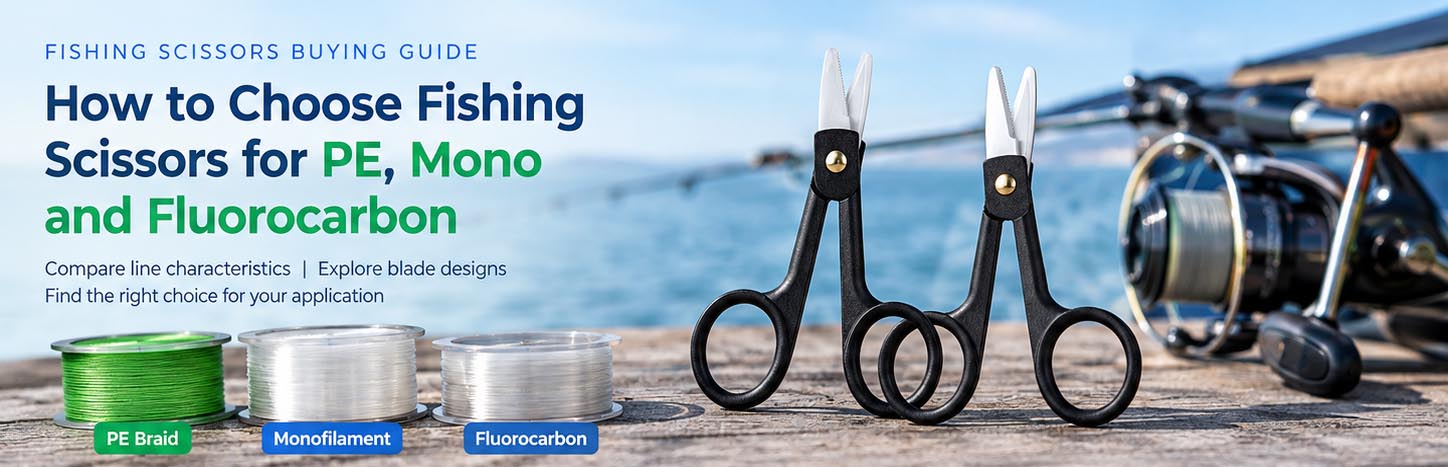
Choosing fishing scissors is not as simple as picking a sharp pair of blades. PE braided line, monofilament and fluorocarbon have different physical properties, and those differences can affect how easily a line is cut, whether it slips between the blades, and how clean the finished cut looks. A pair of scissors that performs well on thin nylon line may not deliver the same results when cutting tightly braided PE line or a thicker fluorocarbon leader.
For anglers, the right choice depends on the fishing techniques they use, the line diameters they regularly cut, and the conditions in which they fish. For fishing tackle brands, distributors and private-label buyers, there are additional questions to consider, including blade material, product consistency, corrosion resistance, and whether one model can serve several applications.
This guide explains how to choose fishing scissors for PE braid, monofilament and fluorocarbon, what to look for in blade design, and when zirconia ceramic scissors may be a suitable option. It also covers practical testing methods that help buyers evaluate a product before adding it to a fishing tackle range.
1. Understand the Differences Between PE, Mono and Fluorocarbon
Before comparing fishing scissors, it helps to understand what happens when each type of line meets a cutting edge. The material, construction, diameter and flexibility of the line all influence the cutting process. There is no single blade design that is automatically best for every fishing application.
PE Braided Line: Multiple Fibers That Can Slip During Cutting
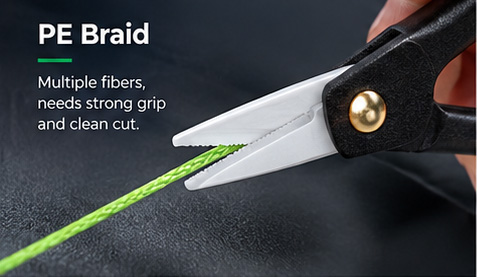
PE braided line is made from multiple synthetic fibers woven together. It is widely used for applications that require a relatively thin line with high tensile strength. Depending on the product, the braid may contain eight, twelve or another number of strands, with differences in construction, coating and overall diameter.
Unlike a single-strand line, braided PE can flatten, shift or separate slightly when pressure is applied. If the blades do not engage the fibers effectively, the line may move between them rather than being cut cleanly. This is one reason some anglers experience frayed ends or find themselves making several attempts to cut the same line.
When choosing fishing scissors for PE braid, pay attention to the blade geometry and how the edges meet. Serrated blades may help engage and hold braided fibers during cutting, although the result depends on the tooth profile, blade alignment and line construction. A well-made straight-edge design can also perform effectively when it is engineered and tested for the intended braid.
For anglers who regularly use PE line, it is worth testing scissors against the actual braid types and diameters they carry. The number of strands alone does not determine cutting performance, and a product that handles one thin braid well may behave differently with another line.
Monofilament: A Single Strand That Needs a Controlled Cut
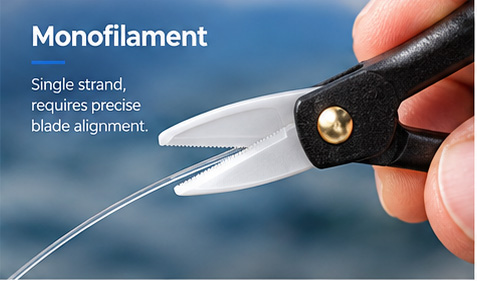
Monofilament fishing line is commonly made from nylon. Unlike braided PE, it consists of a single strand rather than a bundle of woven fibers. It is widely used for general-purpose fishing, main lines, leaders and a range of freshwater and saltwater applications.
Because monofilament is a single strand, it does not present the same fiber-separation problem as braided line. However, thin nylon line can still slide away from a poorly aligned cutting edge, especially when the scissors are dull, the line is loosely held, or the blades do not close evenly.
For monofilament, look for a clean cutting action, reliable blade alignment and a comfortable level of control. These qualities matter when trimming knots, removing excess tag ends or making repeated cuts during rig preparation. The shape of the blade tip can also be useful if the scissors need to reach into a compact area around a hook or rig.
Anglers who use several line diameters should not judge a pair of scissors by a single cut through thin nylon. Testing a few representative sizes gives a more realistic picture of the tool's everyday performance.
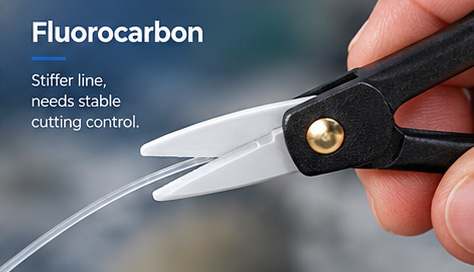
Fluorocarbon: Stiffer Line That Requires Reliable Blade Engagement
Fluorocarbon fishing line is commonly made from polyvinylidene fluoride (PVDF). It is frequently used for leaders and other applications where anglers value its underwater optical properties, abrasion resistance and relatively firm feel. The actual characteristics vary by product and diameter.
Fluorocarbon can feel stiffer than comparable nylon monofilament, particularly in larger diameters. That stiffness can make it more difficult to position and cut cleanly with a small pair of scissors that was designed mainly for light line. A tool may work perfectly well on thin fluorocarbon but struggle when asked to cut a substantially thicker leader.
When selecting scissors for fluorocarbon, consider the maximum line diameter you expect to cut, the amount of control needed around knots and terminal tackle, and whether the blade design can engage the line securely. Do not assume that a scissor advertised as suitable for fishing line will handle every leader size.
For commercial buyers, this distinction is particularly important. If a product is intended for light leader trimming, it should not be marketed as a heavy-leader cutting tool unless its performance has been verified for that application.
Quick Comparison: What Makes Each Line Different?
| Comparison factor | PE braided line | Monofilament | Fluorocarbon |
|---|
| Construction | Multiple braided fibers | Single nylon strand | Single PVDF strand |
| Common cutting concern | Fiber movement, slipping or fraying | Line movement and cut consistency | Stiffness and diameter compatibility |
| Blade design priority | Reliable fiber engagement | Controlled, clean cutting | Stable engagement and sufficient cutting capacity |
| What to test | Different braid constructions and diameters | Thin and medium line sizes | Representative leader diameters |
The practical takeaway is straightforward: choose scissors based on the line you actually use, not just the material named on the packaging. If you regularly switch between PE, nylon and fluorocarbon, the most useful tool is one that has been tested across all three in the diameters relevant to your fishing.
2. What Type of Fishing Scissors Do You Need?
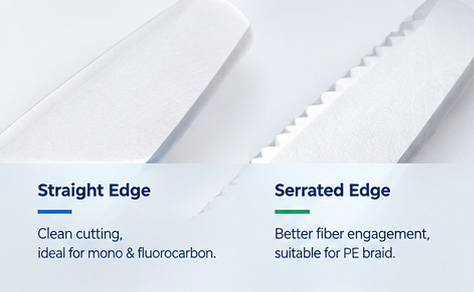
Blade design is one of the first things to compare when selecting fishing scissors. Straight-edge and serrated scissors approach the cutting task differently, and neither design should be considered universally superior. The right option depends on how the edge engages the line, the quality of the blade and the applications the tool is intended to handle.
Straight-Edge Fishing Scissors
Straight-edge scissors have relatively smooth cutting edges without prominent teeth. They are commonly used for general trimming tasks and may work well with monofilament and fluorocarbon when the blades are sharp, properly aligned and suitable for the line diameter.
A smooth edge can provide controlled cutting and may be convenient when trimming excess line close to a knot. For anglers who mainly use single-strand fishing line, this design can be a practical choice.
However, a straight edge is not automatically the best option for every PE braid. If the fibers move away from the cutting edge instead of being held in place, the line may require repeated attempts. Actual performance depends on the edge geometry, closing action, blade alignment and line construction.
Serrated Fishing Scissors
Serrated scissors feature small teeth or notches along part or all of the cutting edge. These teeth can help engage braided fibers and reduce the tendency of the line to slide away during cutting. This makes serrated designs worth considering for anglers who regularly work with PE braided line.
Not all serrated blades are the same. Tooth size, spacing, depth and finishing can affect how the edge interacts with a particular braid. A design with aggressive teeth may behave differently from one with fine serrations, and the result should be evaluated using the intended line types.
Serrated scissors may also be suitable for mixed-line applications, but the presence of teeth alone does not guarantee clean cuts on nylon or fluorocarbon. Buyers should assess the complete cutting action rather than choosing a product solely because its blades are serrated.
For a closer look at this design, see How Serrated Edges Improve Braided Line Cutting.
Ceramic vs. Stainless Steel Fishing Scissors
Blade material is another important consideration. Zirconia ceramic and stainless steel are both used in cutting tools, but they have different physical properties. The choice affects more than initial sharpness: wear resistance, corrosion behavior, impact tolerance and manufacturing quality also matter.
| Factor | Zirconia ceramic | Stainless steel |
|---|
| Corrosion behavior | The ceramic blade itself does not rust like steel | Corrosion resistance depends on the steel grade and exposure conditions |
| Hardness and wear | High hardness and good wear resistance | Depends on steel composition, heat treatment and edge design |
| Impact tolerance | Hard but comparatively brittle; can chip under impact | Generally more tolerant of bending and impact |
| Cutting performance | Depends on edge geometry, finishing and assembly | Also depends on edge geometry, finishing and assembly |
| Best evaluation method | Test the complete tool on the intended fishing lines | Test the complete tool on the intended fishing lines |
Zirconia ceramic can be an attractive choice for fishing scissors because the blade material does not rust and offers high hardness and wear resistance. These characteristics can be valuable for products intended for regular use in wet environments, including saltwater fishing.
There are trade-offs. Ceramic is more brittle than steel and can chip or fracture if dropped, twisted or used in ways outside its design limits. It should not be treated as an impact-resistant substitute for every metal cutting tool.
It is also important to distinguish the blade from the complete scissor assembly. Pivot hardware, fasteners and other metal components may still corrode, even when the cutting edge is ceramic. Buyers evaluating a saltwater product should examine the entire construction and follow the manufacturer's care recommendations.
For fishing tackle brands, the best material choice depends on the product's intended positioning, target users, price range and tested performance. A ceramic blade may offer a meaningful point of differentiation, but the final decision should be based on the complete product rather than material claims alone.
3. How to Choose Fishing Scissors for Each Line Type
Once you understand the differences between the lines and blade designs, the next step is to match the scissors to the application. Start with the line you cut most often, then consider whether the same tool needs to handle other materials and diameters.
Choosing Fishing Scissors for PE Braid
If braided PE is your main line, prioritize reliable fiber engagement. The scissors should cut the intended braid without excessive slipping, repeated closing attempts or unnecessary pulling on the line.
Consider the following factors:
Blade geometry: Compare straight and serrated designs using the PE braid you normally fish with.
Line construction: Test representative braid types, including the strand constructions and coatings relevant to your application.
Line diameter: Check both thin and thicker sizes if your fishing methods require them.
Cut consistency: Look for repeatable results instead of judging the tool by one successful cut.
Fishing environment: If the scissors are frequently exposed to saltwater, consider blade material, pivot hardware and overall corrosion resistance.
A pair of scissors designed for light PE line should not automatically be assumed suitable for every heavy braid. The same applies to claims about cutting speed or edge life: these should be supported by appropriate testing rather than inferred from the blade material alone.
For more detailed guidance, read Best Fishing Scissors for Braided PE Line. That article focuses more closely on the features that matter when choosing scissors specifically for braided fishing line.
Choosing Fishing Scissors for Monofilament
For nylon monofilament, focus on a controlled cut, reliable blade alignment and ease of handling. These factors are useful when trimming knots, preparing rigs or making small adjustments while fishing.
Thin line can be surprisingly demanding. If the blades do not meet cleanly, the line may fold or move instead of being cut. A well-finished edge and a stable closing action can make a noticeable difference in day-to-day use.
Consider whether you need a fine tip for precision trimming, a compact body for a tackle box, or a handle that remains comfortable during repeated use. If you also cut PE braid, check that the selected design performs well on that line rather than assuming that good monofilament performance guarantees good braid cutting.
Ceramic scissors may be worth considering if corrosion resistance and wear resistance are important to your product requirements. However, blade material should be evaluated alongside cutting performance, handling and the durability of the complete assembly.
For a more focused discussion, see Ceramic Scissors for Monofilament Fishing Line.
Choosing Fishing Scissors for Fluorocarbon
Fluorocarbon selection requires particular attention to line diameter and stiffness. A compact pair of fishing scissors may be perfectly suitable for trimming light leaders but less effective when cutting a thicker fluorocarbon line.
Before choosing a model, consider these questions:
What is the largest fluorocarbon diameter you expect to cut regularly?
Will the scissors mainly trim tag ends, or must they also cut leader material during rig preparation?
Does the blade engage the line securely, or does the line move away during closing?
Can the tool make consistent cuts without excessive force?
Will it also be used for PE braid or monofilament?
Do not force a small pair of scissors through line that exceeds its intended cutting capacity. Excessive force can damage the tool and create an uncontrolled cut. When a product is intended for heavier leaders, its compatibility should be confirmed through specifications and practical testing.
For a more detailed explanation of ceramic blades and fluorocarbon line, visit Can Ceramic Scissors Cut Fluorocarbon Fishing Line?.
Can One Pair of Fishing Scissors Handle All Three Line Types?
Yes, a single pair of scissors can be designed to handle PE braid, monofilament and fluorocarbon, provided its blade geometry and cutting capacity suit the intended line types and diameters. However, multi-line compatibility should be verified rather than assumed.
For anglers, a versatile pair can reduce the number of tools carried in a tackle box. For fishing tackle brands and retailers, a multi-purpose product may also be easier to position for users who switch between different fishing methods.
The important question is not whether a scissor can cut each material once. It is whether it can deliver acceptable, repeatable results across the intended range of line types without excessive effort or premature edge damage.
If you plan to use one pair for all three materials, test it with representative PE braid, nylon monofilament and fluorocarbon samples. Include the thinnest and thickest sizes the product is expected to support. This is a more reliable basis for selection than a general-purpose label on the packaging.
4. Key Features to Check Before Buying Fishing Scissors
Once you have identified the fishing line types you need to cut, it becomes easier to compare individual products. Two pairs of scissors may look similar in a product photo but perform differently because of their blade geometry, assembly quality, handle design and material selection.
Whether you are buying a single pair for personal use or evaluating a product for a commercial range, the following features deserve attention.
Blade Material and Manufacturing Quality
The blade material influences corrosion behavior, wear resistance and impact tolerance, but the quality of the finished edge is equally important. A high-hardness material does not automatically produce a clean cut. Grinding, edge finishing, dimensional control and final assembly all affect how the scissors perform.
Zirconia ceramic is an option worth considering when corrosion resistance and wear resistance are important product requirements. Unlike steel, the ceramic blade itself does not rust. This can be a useful advantage for fishing tools exposed to water, provided the other components are also suitable for the intended environment.
For commercial buyers, ask how the supplier controls manufacturing consistency. Relevant questions include whether the blade specifications are documented, how finished products are inspected, and whether samples and bulk production are evaluated against the same requirements.
Blade Geometry and Alignment
The shape of the cutting edge influences how the scissors engage a fishing line. Straight edges, serrated edges and different tip profiles each serve particular purposes. Blade alignment is also important: if the edges do not meet consistently, even a sharp blade may struggle with thin line or produce uneven results.
When evaluating a product, check whether the blades close smoothly along the intended cutting area. Look for unwanted gaps, excessive lateral movement or inconsistent contact between the edges. These details may be difficult to judge from a product photograph, which is why physical sample evaluation remains valuable.
Line Diameter Compatibility
Line compatibility should be treated as a defined product requirement rather than a broad marketing claim. PE braid, monofilament and fluorocarbon are available in many diameters and constructions. A tool that works well with thin line may not be appropriate for thicker leaders.
Before buying, identify the line types and diameter range relevant to your application. If the scissors are intended for retail sale, these requirements should also inform the product description and packaging claims. Clear compatibility information helps customers choose the right tool and reduces the risk of disappointing performance expectations.
Corrosion Resistance for Freshwater and Saltwater Use
Fishing scissors are frequently used in wet conditions, and saltwater can be particularly demanding on metal components. A ceramic blade offers an advantage because the blade material does not rust like steel. However, the pivot, fasteners, springs and other metal parts may still corrode if their materials and finishes are unsuitable.
For saltwater applications, examine the complete scissor assembly rather than relying on the blade material alone. Consider the hardware, construction, cleaning requirements and storage recommendations. If corrosion resistance is a key selling point, confirm the claim through appropriate testing of the finished product.
Grip, Portability and Attachment
Cutting performance is only part of the user experience. Fishing scissors should also be comfortable to handle, easy to store and convenient to retrieve when needed. Handle shape, finger clearance, overall size and opening action can all affect practical usability.
Compact designs are useful for anglers who carry limited tackle, while an attachment point or hanging clip may make the tool easier to keep within reach. These details can also help differentiate products in a crowded retail category.
For fishing tackle brands, it is worth evaluating whether the handle color, surface finish, attachment style and packaging fit the intended market. A product's commercial appeal comes from the combination of practical performance, appearance and positioning, not from a single specification.
5. How to Test Fishing Scissors Before Making a Purchase
A short cutting demonstration can be useful, but it is not enough to establish whether a pair of fishing scissors is suitable for repeated use. The most informative evaluation uses representative line samples, consistent test conditions and clear acceptance criteria.
This is especially important for distributors, fishing tackle brands and private-label buyers who need to make decisions before placing a larger order.
Test All Three Line Types Separately
Start by identifying the PE braid, monofilament and fluorocarbon products the scissors are expected to cut. Use actual samples where possible, including representative diameters and line constructions. If your target market includes several fishing techniques, select samples that reflect those applications rather than testing only one convenient line.
For PE braid, observe whether the fibers remain engaged with the cutting edge or slip between the blades. Inspect the cut end for unwanted fraying and note whether repeated closing attempts are necessary.
For monofilament, check whether the scissors produce a controlled cut without pushing the line away. Test different diameters if the tool is expected to serve both light and general-purpose fishing applications.
For fluorocarbon, focus on the intended leader diameter and the amount of effort required. A result obtained with thin fluorocarbon should not be used to support a claim about much thicker line.
Evaluate More Than a Simple Cut-or-No-Cut Result
It is easy to demonstrate that scissors can cut a piece of fishing line. A useful product evaluation asks whether they can do so consistently, comfortably and within the intended operating range.
Cut consistency: Does the tool produce similar results across repeated attempts?
Line slippage: Does the line remain engaged with the blade, or move away during cutting?
Cut quality: Is the cut acceptable for the intended task, including knot trimming and leader preparation?
Handling effort: Can the user operate the scissors comfortably without excessive force?
Edge condition: Does repeated use reveal chipping, visible damage or a decline in cutting performance?
Assembly stability: Does the pivot remain secure and the closing action consistent during the evaluation?
For a more structured comparison, record the line brand, material, diameter, number of cutting attempts and observed results. If several scissor models are being compared, use the same line samples and test procedure for each one.
These records are particularly useful for commercial purchasing. They help separate measurable performance differences from subjective impressions and provide a clearer basis for approving a product.
What OEM Buyers Should Verify with a Supplier
For an OEM or private-label project, sample testing should be connected to the eventual production specification. Otherwise, an approved sample may not provide enough information to evaluate the consistency of a future order.
Before proceeding, clarify the following points with the supplier:
Product specifications: Confirm the blade material, dimensions, intended line applications and other relevant product details.
Sample evaluation: Agree on which line types and diameters will be used to assess the sample.
Production consistency: Ask how finished products are inspected and how key requirements are checked during production.
Customization: Confirm available options for logo placement, handle color, attachment accessories and packaging.
Commercial terms: Clarify minimum order quantity, sample arrangements, lead time and quality inspection requirements.
Product claims: Make sure performance, durability and corrosion-related claims are supported by appropriate evidence.
These questions help buyers understand not only whether a sample works, but also whether the supplier can support a repeatable commercial product. A clear specification and an agreed approval process are often more useful than a long list of unverified performance claims.
6. Choosing Fishing Scissors for Your Brand or Product Line
For commercial buyers, selecting fishing scissors involves more than comparing two products on a technical basis. The tool must fit the intended customer, retail positioning, price range and overall product assortment. The most suitable specification for a specialist PE braid tool may be different from the specification for a compact, multi-purpose fishing scissor.
For Fishing Tackle Brands
Fishing tackle brands should begin with a clear definition of the product's role. Is it intended for anglers who primarily use braided PE line, users who frequently trim monofilament and fluorocarbon leaders, or customers who prefer one compact tool for several tasks?
This decision influences the blade geometry, product dimensions, handle design and claims that can reasonably be made. A focused product designed around a particular use case may be easier to differentiate than a general-purpose product with an overly broad list of promises.
Brands should also consider the relationship between the scissors and their existing products. A line-focused scissor can complement a braided line range, while a corrosion-resistant ceramic model may fit a premium saltwater accessory collection. The positioning should reflect the product's verified capabilities and the needs of the target market.
For Distributors and Wholesalers
Distributors and wholesalers need a product that can be explained clearly to retailers and end users. Practical selection criteria include line compatibility, ease of use, material characteristics, packaging and the availability of reliable product information.
When evaluating a supplier, look beyond the sample's appearance. Ask whether the product specification is stable, what inspection arrangements are available, and how customization or repeat orders will be managed. These details help buyers assess the supplier relationship as well as the product itself.
It is also useful to consider assortment planning. A single multi-purpose model may suit some distribution channels, while specialist models may make more sense when the customer base includes distinct groups of braid, leader or saltwater fishing users.
For Amazon Sellers and Private-Label Buyers
Private-label buyers must connect product selection with the claims and images used in their listings. If a listing states that the scissors are suitable for PE braid, monofilament and fluorocarbon, those applications should be evaluated before the claim is published.
Logo customization, handle color, packaging and accessories may help establish a consistent brand identity. However, visual differentiation should not replace product validation. A well-presented product still needs a clear specification and performance that matches its advertised use.
Before bulk production, confirm the approved sample, customization details, packaging artwork and any product claims that require verification. This process helps reduce avoidable differences between the sample used for evaluation and the product eventually supplied to customers.
7. Why Consider MIDDIA Ceramic Fishing Scissors?
For buyers exploring ceramic fishing scissors, MIDDIA offers a starting point for discussing product requirements, application suitability and private-label possibilities. The right configuration depends on the intended line types, target users and product specifications, so it is worth defining these requirements before selecting a model.
Zirconia Ceramic Manufacturing Experience
Zirconia ceramic is used in cutting applications where hardness, wear resistance and corrosion behavior are important considerations. Turning the material into a useful fishing scissor, however, requires more than selecting a ceramic blade. Edge finishing, assembly, handling and the intended cutting application all contribute to the final product.
When evaluating MIDDIA ceramic fishing scissors, buyers should focus on the specifications and sample performance relevant to their market. This includes the intended line types, compatible diameters, blade configuration and requirements for everyday or saltwater use.
Designed Around Fishing-Line Applications
PE braid, monofilament and fluorocarbon present different cutting requirements. For this reason, the selection process should begin with the application rather than assuming that every ceramic scissor will perform identically across all three materials.
Buyers can identify their target line types and diameters, then evaluate suitable product configurations using actual samples. This approach makes it easier to determine whether a particular model fits a specialist fishing tool range or a multi-purpose accessory offering.
It also creates a more useful basis for product positioning. Instead of relying on a broad claim such as "cuts every fishing line," brands can describe the applications and specifications that have actually been evaluated.
OEM/ODM and Private-Label Support
For fishing tackle brands, distributors and trading companies, a ceramic fishing scissor project may involve more than selecting an existing product. Logo placement, handle color, attachment accessories and retail packaging can all form part of the discussion, subject to the supplier's available customization options.
A practical starting point is to share the target market, intended line applications, preferred product style and estimated purchasing requirements. These details help establish which specifications need to be confirmed and whether sample evaluation should take place before a larger order.
If you are developing a new fishing accessory or expanding an existing product range, you can contact MIDDIA about ceramic fishing scissors and OEM/ODM requirements. Include your target line types, intended applications and customization needs so the discussion can focus on a suitable product specification.
Frequently Asked Questions
Q1. Can One Pair of Fishing Scissors Cut PE Braid, Mono and Fluorocarbon?
Yes, a suitably designed pair of fishing scissors may handle all three line types. Performance depends on blade geometry, alignment, line construction and diameter. Test representative samples of PE braid, monofilament and fluorocarbon before assuming that one model is suitable for every application.
Q2. Are Ceramic Fishing Scissors Better Than Stainless Steel Scissors?
Neither material is automatically better for every fishing task. Zirconia ceramic offers high hardness, wear resistance and a blade that does not rust, but it is more brittle than steel. Stainless steel offers different mechanical properties, and its corrosion resistance depends on the grade and construction. The complete tool should be evaluated for the intended use.
Q3. Are Serrated Scissors Always Better for Braided PE Line?
No. Serrations can help engage braided fibers and reduce slipping, but results depend on the tooth profile, blade alignment and line construction. A well-designed straight-edge scissor may also work with certain braids. The most reliable choice is the one that performs consistently on the actual line you intend to cut.
Q4. Can Ceramic Scissors Cut Thick Fluorocarbon Leaders?
That depends on the scissor design and the diameter of the fluorocarbon. A compact model intended for light line should not be assumed suitable for heavy leaders. Check the manufacturer's specifications and test the intended line diameter before using or marketing the scissors for that application.
Q5. Are Ceramic Fishing Scissors Suitable for Saltwater Fishing?
Ceramic blades do not rust like steel, which can be useful in saltwater environments. However, the pivot, fasteners and other metal components may still corrode. Evaluate the complete assembly, follow the care instructions and confirm any saltwater performance claims through appropriate testing.
Q6. Can Fishing Tackle Brands Order OEM or Private-Label Ceramic Scissors?
OEM and private-label arrangements depend on the supplier's available products and customization capabilities. Buyers should confirm logo options, handle colors, packaging, minimum order quantities, sample arrangements and production lead times. A sample approval process can help establish the requirements for the final product.
Choose the Right Fishing Scissors for Your Application
The best fishing scissors are not necessarily the ones with the longest feature list or the most impressive material claim. They are the ones that perform reliably on the lines you actually use, fit the intended cutting tasks and offer the right balance of control, durability and convenience.
For PE braid, pay close attention to fiber engagement and cutting consistency. For monofilament, look for controlled cutting and reliable blade alignment. For fluorocarbon, confirm compatibility with the intended leader diameter rather than relying on a general fishing-line claim.
If you are choosing a pair for personal use, test it against your regular line types. If you are a fishing tackle brand, distributor or private-label buyer, add sample evaluation, specification control and production consistency to your selection criteria.
Looking for the Right Fishing Scissors for Your Product Line?
Whether your customers use braided PE, monofilament, or fluorocarbon line, choosing the right cutting tool can make a difference in everyday fishing performance. MIDDIA supplies ceramic fishing scissors for fishing tackle brands, wholesalers, and private-label businesses, with OEM/ODM customization options to meet different product requirements.
Tell us about your target line applications, preferred scissor design, branding needs, and order quantity. Our team can help you explore suitable ceramic fishing scissors for your market.
Discuss Your Fishing Scissors Requirements
