Fluorocarbon fishing line is a popular choice for leaders because it offers useful abrasion resistance, low visibility underwater, and a different feel from many nylon monofilament lines. But when it is time to change a leader, trim a tag end, or prepare a new rig, one small problem can become surprisingly frustrating: getting a clean cut without the line slipping between the blades.
This is where the choice of scissors starts to matter. Some anglers prefer conventional stainless steel fishing scissors, while others look for ceramic-blade alternatives. Both materials have practical advantages, and neither automatically guarantees a perfect cut. Blade geometry, edge sharpness, scissor tension, line diameter, and overall construction all influence the result.
So, when comparing ceramic vs stainless steel for fluorocarbon line cutting, which option makes more sense? The answer depends on how the scissors will be used, what kind of fluorocarbon line they need to handle, and which features matter most over time. For fishing tackle brands and distributors, the same question also involves product positioning, durability expectations, and the needs of the customers who will eventually use the scissors.
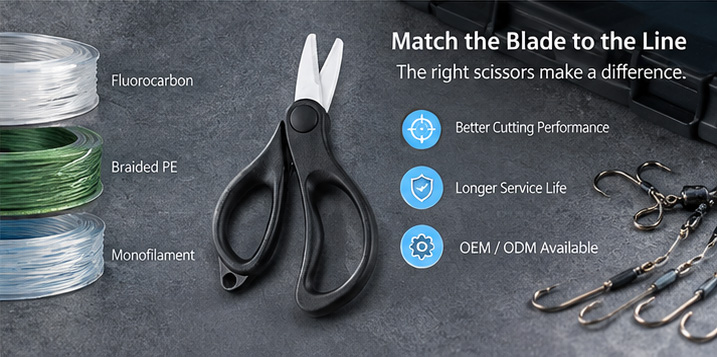
Fluorocarbon is commonly used for leaders and other fishing applications where abrasion resistance, underwater visibility, and line stiffness are important considerations. These characteristics are useful on the water, but they can make cutting performance more dependent on the scissors being used.
Fluorocarbon line is generally made from polyvinylidene fluoride (PVDF). Compared with many nylon monofilament lines, it often feels stiffer and may be more resistant to bending, depending on its diameter and formulation. A smooth line can also be difficult to hold in the ideal cutting position when the blades first make contact.
That does not mean every fluorocarbon line is difficult to cut. Thin leader material may be easy to trim with a well-made pair of scissors, while a heavier leader can require more cutting force and better control. Two lines with similar diameters may also behave differently because of differences in construction, stiffness, and material formulation.
For this reason, the phrase “fluorocarbon scissors” does not describe one universal cutting requirement. A tool designed for trimming fine leader material may not be the right choice for cutting thick fluorocarbon leaders. The intended line diameter should always be considered alongside the blade material.
When a pair of scissors struggles to cut fluorocarbon, the problem is not necessarily the material of the blade. Several factors may be involved.
Edge sharpness: A worn or poorly finished edge may press against the line instead of cutting through it efficiently.
Blade geometry: The angle and shape of the cutting edges affect how the line is engaged.
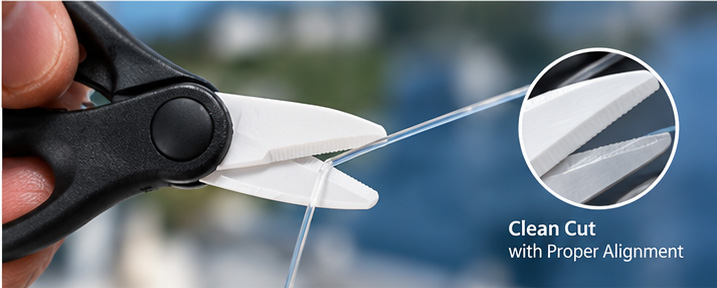
Blade alignment: If the blades do not meet properly, the line may be pushed aside rather than severed cleanly.
Scissor tension: A loose pivot or unsuitable blade tension can reduce control during cutting.
Line diameter and stiffness: Heavier or stiffer fluorocarbon can place different demands on the cutting mechanism.
Cutting technique: The position of the line between the blades and the way pressure is applied can influence the result.
These details explain why an expensive pair of scissors does not always outperform a simpler model in every situation. The complete cutting system matters. A well-designed stainless steel pair may cut fluorocarbon very cleanly, while a ceramic-blade model with poor alignment or unsuitable geometry may disappoint the user.
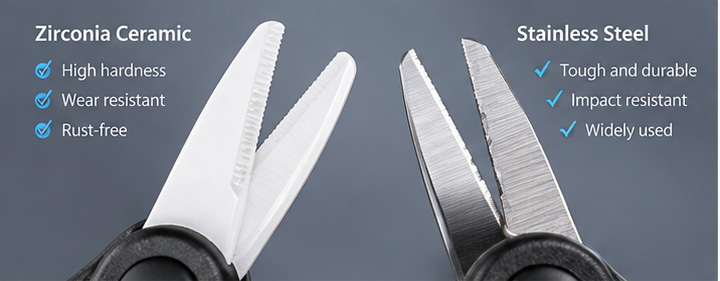
Blade material establishes some important performance characteristics, but it is only one part of the design. Zirconia ceramic is valued for its high hardness and wear resistance. Stainless steel offers a broad range of properties, including different combinations of hardness, toughness, corrosion resistance, and ease of manufacturing.
Those differences are meaningful, but they do not tell the whole story. Edge geometry determines how the cutting edges contact the line. Blade alignment influences whether the line remains securely positioned. Handle design and pivot construction affect the amount of control the user can apply.
For fluorocarbon cutting, the more useful question is not simply which material is better. It is whether a particular pair of scissors combines the right material, edge design, and mechanical construction for its intended application.
The two materials are worth comparing across several practical factors: cutting performance, wear resistance, corrosion resistance, impact tolerance, and maintenance. For buyers evaluating fishing scissors, these factors should be considered together rather than treated as separate promises of product quality.
Zirconia ceramic blades are made from a hard technical ceramic rather than a conventional metal alloy. When properly manufactured and ground, they can provide a sharp cutting edge with good wear resistance. This makes ceramic a useful material to consider for compact cutting tools that are expected to retain their edge through repeated use.
However, ceramic does not automatically cut fluorocarbon better than stainless steel. The result depends on the finished edge, blade shape, closing action, and the diameter of the line. A ceramic blade with unsuitable geometry can still allow line slippage or produce an inconsistent cut.
Stainless steel scissors can also deliver clean, controlled cuts. Their performance varies with the steel grade, heat treatment, grinding quality, and mechanical design. A properly finished stainless steel edge can work well for routine leader trimming, particularly when the scissors are matched to the intended line diameter.
For anglers, the practical test is straightforward: does the tool cut the line cleanly and consistently without requiring excessive force or repeated attempts? For product developers, the same question should be tested across the actual line types and diameters their customers are likely to use.
One of zirconia ceramic's key characteristics is its high hardness. This contributes to its resistance to abrasive wear and can help a properly designed cutting edge maintain its condition during use. For fishing scissors, that may be an advantage when consistent cutting performance is a priority.
Stainless steel is not a single material with one fixed level of hardness or wear resistance. Different grades and heat treatments can produce substantially different results. Some steel scissors are designed for economical everyday use, while others use more carefully selected materials and edge treatments.
It is therefore misleading to compare ceramic with an unspecified category of stainless steel and assume that every ceramic product will last longer. Actual edge retention depends on the blade material, edge thickness, manufacturing quality, cutting frequency, and the materials being cut.
It is also important to distinguish wear resistance from impact resistance. A material that resists gradual edge wear may still be more vulnerable to chipping if it is struck against a hard surface. Ceramic blades should be evaluated for their intended use rather than judged by hardness alone.
Corrosion resistance is one of the clearest differences between a zirconia ceramic cutting edge and a stainless steel cutting edge. Zirconia ceramic does not rust like a metal blade. This can be attractive to anglers who regularly fish in saltwater or prefer a cutting edge that does not require the same corrosion-related attention as a metal edge.
Stainless steel offers varying degrees of corrosion resistance, depending on its composition, surface condition, and exposure conditions. The term “stainless” does not mean that the material is completely immune to corrosion. Salt deposits, prolonged moisture, surface damage, and unsuitable material selection can all affect performance over time.
There is one important qualification for ceramic fishing scissors: the blade is only one part of the product. The pivot, screws, springs, and other metal components may still be exposed to moisture and salt. A ceramic blade does not make the entire tool corrosion-proof.
For fishing tackle brands, this distinction matters when developing products for saltwater markets. Blade material, hardware selection, assembly quality, and care instructions should be considered as a complete product specification. Claims about saltwater suitability should be supported by appropriate evaluation of the finished scissors, not based on the blade material alone.
Fishing scissors do not always stay on a clean workbench. They may be carried in a tackle box, used on a boat, dropped onto a hard deck, or stored alongside hooks and other equipment. These everyday conditions make toughness an important consideration, not just cutting sharpness.
Stainless steel generally offers greater tolerance for impact and deformation than zirconia ceramic. Depending on the steel grade and product construction, a metal blade may be better suited to users who frequently handle their tools roughly or work in demanding environments.
Zirconia ceramic has a different performance profile. Its high hardness and wear resistance can be useful for maintaining a cutting edge, but ceramic is more brittle than steel. A ceramic blade may chip or fracture if it is dropped onto a hard surface or subjected to excessive twisting, prying, or lateral force.
This does not make ceramic unsuitable for fishing scissors. It means that product design and intended use must be considered carefully. Blade support, edge geometry, handle construction, and sensible handling instructions all contribute to the finished tool's performance.
For brands developing ceramic fishing scissors, it is worth evaluating how the product will actually be used. A compact leader cutter intended for controlled line trimming has different requirements from a general-purpose tool that customers may use for tasks beyond its intended scope.
Maintenance is another point of comparison. Because a zirconia ceramic blade does not rust like a metal blade, it can reduce concerns about corrosion at the cutting edge. This is particularly relevant for anglers who frequently move between freshwater and saltwater environments.
Stainless steel scissors may require more attention to cleaning and drying, depending on the steel grade, the environment, and the condition of the tool. Even corrosion-resistant steel benefits from rinsing away salt deposits after saltwater use and storing the scissors in a dry place.
Neither material removes the need for basic care. The pivot can collect debris, mechanical tension can change with use, and other metal components can corrode. Ceramic blades also need protection from impact and inappropriate use.
For buyers comparing long-term ownership costs, it is useful to consider more than the initial purchase price. Expected service life, replacement frequency, product maintenance, customer expectations, and the cost of returns all contribute to the overall value of a pair of scissors. These factors should be assessed using actual product performance and customer feedback rather than assumptions based on material alone.
The right choice depends partly on the type of fluorocarbon line being cut. Thin leaders, medium-diameter line, and heavy leaders do not place identical demands on a pair of scissors. Fishing conditions and the user's cutting habits matter as well.
Thin fluorocarbon leaders are often used in applications where a neat tag end and precise rig preparation are important. At these diameters, blade sharpness, alignment, and control can have a noticeable effect on the cutting experience.
A well-made ceramic pair may be worth considering when edge wear resistance and blade-level corrosion resistance are priorities. A properly designed stainless steel pair can also perform well. There is no universal material-based rule that makes one option superior for every thin leader.
For this application, buyers should look for consistent cutting performance with the actual line diameter they expect to use. The line should remain properly positioned during the cut, and the scissors should close smoothly without excessive pressure. These practical details are more useful than a general claim that a blade is simply sharper.
As fluorocarbon diameter increases, stiffness and the force required to cut the line can become more important. The scissors must provide enough leverage and maintain suitable blade contact throughout the closing action.
Both ceramic and stainless steel may be suitable, provided the complete design matches the application. A compact pair designed for light leader trimming should not automatically be assumed to handle thicker line just because its blade is made from a hard material.
For fishing tackle manufacturers and distributors, medium-diameter fluorocarbon is a useful category to include in product evaluation. Test samples with the line diameters customers commonly use, and record whether the scissors produce clean cuts consistently. Repeating the test across multiple samples can also help identify differences in manufacturing consistency.
Heavy fluorocarbon leaders require more careful tool selection. The additional material may demand greater cutting force, and the design must accommodate the line without causing the blades to separate, bind, or lose proper contact.
In this situation, blade material alone is not enough to determine suitability. Blade thickness, edge geometry, scissor leverage, pivot strength, and the manufacturer's intended line capacity all deserve attention.
Users should follow the manufacturer's guidance on supported line diameters. If no clear specification is available, it is better to test the scissors with the intended line before relying on them for routine use. Repeatedly forcing a small cutter through line that exceeds its intended capacity can compromise performance and may damage the tool.
For product developers, this is also an opportunity to define clearer product specifications. A model designed for light leader trimming and a model intended for heavier leader material may need different blade configurations, handle designs, and performance criteria.
Saltwater use adds another consideration to the material decision. Anglers may use their scissors while rigging leaders on a boat, changing terminal tackle near the water, or preparing equipment between fishing sessions. The tool may be exposed to salt spray, wet hands, and damp storage conditions.
A zirconia ceramic blade offers a clear advantage at the blade level because it does not rust like a metal cutting edge. This characteristic can make ceramic an appealing option for saltwater-oriented fishing accessories, particularly when users value reduced concern about blade corrosion.
However, a saltwater-ready product needs more than a ceramic blade. The pivot, fasteners, springs, and any other exposed metal parts should be selected and evaluated with the intended environment in mind. Product packaging and care instructions should also explain how to clean and store the finished tool.
For brands targeting saltwater anglers, a useful evaluation should include cutting performance before and after the relevant environmental exposure, inspection of the mechanical components, and a check for changes in blade alignment or opening and closing action. Such testing provides a more reliable basis for product claims than the phrase “rustproof ceramic scissors” on its own.
Material comparisons can be useful, but edge design deserves equal attention. The geometry of the cutting edges affects how a smooth line is positioned, engaged, and separated. For brands selecting a fishing scissor design, this is one of the most practical areas to investigate during sample evaluation.
Straight-edge scissors use relatively smooth cutting edges. When the blades are correctly aligned and sufficiently sharp, they can provide controlled cuts across a range of suitable materials. Their performance on fluorocarbon depends on the quality of the edge, the closing action, and how securely the line stays between the blades.
Serrated edges have small teeth or grooves designed to engage material as the blades close. Depending on the geometry, serrations may help grip a smooth line and reduce the tendency for it to move away from the cutting area. However, not all serrated patterns behave the same way, and serrations do not guarantee a cleaner cut in every application.
For fluorocarbon, the important question is whether the edge configuration can hold the intended line securely while cutting it cleanly. Very fine line, heavier leader material, and other types of fishing line may respond differently to the same blade geometry.
It is also worth distinguishing serration from material. A serrated stainless steel blade and a straight ceramic blade have two different combinations of characteristics. A fair comparison should consider both edge configuration and blade material instead of attributing every difference in performance to one factor.
The blades need to meet correctly throughout their closing movement. If they are misaligned, too loose, or unable to maintain suitable contact, a line may be pushed between them instead of being cut efficiently.
Scissor tension also affects control. A pivot that is too loose may allow unwanted movement, while excessive tension can make the tool difficult to operate. The right balance depends on the product's construction and intended application.
These mechanical details are particularly important when developing compact fishing scissors. A well-chosen blade material cannot compensate for poor assembly or unsuitable tolerances. For buyers, evaluating the complete tool is therefore essential.
Some fishing scissors are designed to handle more than one type of line. This can be convenient for anglers and may allow brands to offer a versatile cutting tool rather than separate products for every application.
However, fluorocarbon, braided PE line, and nylon monofilament differ in construction and cutting behavior. Braided line consists of multiple fibers that can spread or slip under the blades. Fluorocarbon is typically stiffer, while nylon monofilament may have a different combination of flexibility and elasticity.
A design that works well on one material may not deliver the same results on another. Serrations, edge sharpness, blade alignment, and the supported line diameter should all be considered when evaluating a multi-purpose cutter.
For this reason, manufacturers should test each intended line type separately. If a product is marketed for fluorocarbon, PE braid, and monofilament, its specifications and performance claims should be based on testing that covers those actual applications. MIDDIA's ceramic fishing scissors can be evaluated in this context, with the appropriate model and configuration selected according to the target lines and intended use.
For an individual angler, the decision may come down to cutting performance, maintenance, and budget. For a fishing tackle brand or distributor, the decision is broader. The blade material needs to fit the target market, retail positioning, expected usage, and overall product specification.
Different customer groups may value different product characteristics. A brand selling entry-level freshwater accessories may prioritize accessible pricing, simple handling, and dependable everyday performance. A brand serving saltwater anglers may place greater emphasis on blade corrosion resistance and the condition of exposed hardware after repeated use.
Premium fishing tackle ranges may have another objective: offering a product with a clear reason to choose it over conventional alternatives. Zirconia ceramic can provide a useful point of differentiation when the brand can explain its hardness, wear resistance, and blade-level corrosion resistance accurately.
None of these positioning options makes one material universally correct. The best decision depends on the needs of the intended customer and the evidence available to support the product's performance claims.
Before contacting a manufacturer, it helps to define the intended application as clearly as possible. A request for “ceramic fishing scissors” leaves many important questions unanswered. More detailed requirements make it easier to assess whether a proposed design is suitable.
Target line types: Identify whether the product is intended for fluorocarbon, PE braided line, monofilament, or a combination of these materials.
Line diameter range: Specify the approximate diameter range that the scissors should be designed to cut.
Blade material and edge configuration: Clarify whether zirconia ceramic or stainless steel is preferred and whether a straight or serrated edge is required.
Handle and portability: Consider grip comfort, compactness, storage, and any attachment features required for the target market.
Environmental requirements: Describe whether the product is intended for freshwater, saltwater, or mixed use.
Retail positioning: Establish the target price range, packaging expectations, and desired product features.
These details provide a practical starting point for product development. They also reduce the risk of receiving samples that look suitable but do not match the actual cutting requirements.
Sample evaluation is an important step before placing a large order. It allows a buyer to check whether the finished product performs as expected and whether the manufacturer's proposed specifications match the needs of the target market.
For fluorocarbon cutting, begin with the line types and diameters the product is intended to handle. Use a consistent cutting method and record whether the line is severed cleanly, whether it slips, and whether repeated attempts are required. Testing more than one sample can help reveal variation between units.
It is also useful to inspect the scissors after repeated cutting. Check the edge condition, blade alignment, pivot movement, and handle integrity. If the product is intended for saltwater use, evaluate the finished tool under a defined exposure and cleaning procedure, paying attention to the blade and all exposed metal components.
Where possible, compare the proposed product with a reference tool already used by your team. A consistent comparison is more informative than relying on memory or a general impression from a single cut.
Finally, agree on the specifications and acceptance criteria before bulk production. For example, define the intended line diameter range, expected cutting behavior, cosmetic requirements, packaging details, and any checks that should be repeated during production. The precise criteria will depend on the product, but establishing them in advance helps both the buyer and manufacturer work toward the same result.
For fishing tackle brands looking beyond conventional metal cutting tools, ceramic fishing scissors offer another option to consider. The value is not simply that the blade is made from ceramic. It is how the material, blade configuration, and finished product fit the intended application and the expectations of the customer.
MIDDIA focuses on ceramic cutting tools, including ceramic fishing scissors for line-cutting applications. For brands, wholesalers, distributors, and private-label sellers, this provides a starting point for discussing product specifications and evaluating whether a ceramic-blade design belongs in their existing fishing tackle range.
MIDDIA's ceramic manufacturing background dates back to 2010. This experience provides a foundation for developing ceramic cutting products, from material selection and forming to sintering, grinding, and finished-part inspection, according to the requirements of each product.
For ceramic fishing scissors, manufacturing quality matters because the performance of the finished blade depends on more than the raw material. Edge geometry, grinding quality, dimensional consistency, and the way the blade works with the scissor mechanism all influence the user's experience.
Buyers should therefore look beyond a general claim of ceramic hardness when evaluating a supplier. It is reasonable to ask about the proposed blade configuration, product specifications, quality inspection process, and the testing available for the intended line-cutting application.
Specific technical tolerances, service-life expectations, and cutting-performance claims should be confirmed against the relevant product documentation and sample results. This helps ensure that product descriptions accurately reflect what the finished scissors can deliver.
Different fishing lines create different cutting requirements. Fluorocarbon leaders may require careful control and a suitable edge geometry, while PE braided line presents a different challenge because of its multiple flexible fibers. Nylon monofilament has its own combination of flexibility, diameter, and cutting behavior.
For brands considering a ceramic fishing scissor range, the intended line applications should be defined before a final configuration is selected. Relevant considerations include the line types, diameter range, edge design, handle requirements, and whether the product is intended primarily for freshwater or saltwater use.
Rather than assuming one design will perform equally well across every line type, buyers should evaluate the proposed configuration against their intended applications. This approach makes it easier to choose a suitable product and build more credible product specifications for customers.
It also creates an opportunity to develop a clearer product range. A compact line cutter for everyday leader trimming may serve a different market segment from a multi-purpose fishing scissor designed to handle several types of fishing line. The appropriate approach depends on the target customer, expected use, and verified product performance.
For businesses developing their own fishing accessory brands, the next step may involve more than purchasing an existing product. They may need a particular handle color, logo placement, packaging format, or product configuration that fits their existing range.
MIDDIA can be approached to discuss OEM and ODM opportunities for ceramic fishing scissors, subject to the requirements and capabilities applicable to the specific project. Potential discussion points include:
Private-label branding: Discuss logo placement and the branding requirements for your product range.
Product configuration: Review available models and discuss whether the proposed blade and handle design fit your target applications.
Packaging: Consider retail packaging, product presentation, and information required for your market.
Sample evaluation: Assess the proposed scissors against your target line types, diameter range, and performance expectations before committing to bulk production.
Wholesale supply: Discuss order quantities, specifications, lead times, and other commercial terms for your project.
The most productive starting point is a clear description of the product you want to develop. If you already sell fishing scissors or line cutters, sharing your current product positioning and the features you want to improve can help make the discussion more specific.
For a new product launch, it is equally useful to identify your target customer, expected retail price, and intended fishing applications. These details help establish whether a ceramic-blade product is a suitable fit and which specifications should be reviewed first.
Not in every situation. Zirconia ceramic offers high hardness, good wear resistance, and excellent resistance to blade rust. Stainless steel generally offers better tolerance for impact and deformation. Actual cutting performance depends on blade geometry, edge quality, alignment, scissor tension, and line diameter. The most suitable option is the one that performs consistently under the intended conditions.
Yes. Well-designed stainless steel scissors can cut fluorocarbon cleanly when the material, edge geometry, and mechanical construction are appropriate for the line. A sharp, properly aligned blade with suitable tension is important. Stainless steel should not be dismissed simply because ceramic is harder; the complete design determines how well the scissors perform in practice.
Zirconia ceramic's high hardness can provide strong resistance to edge wear, which may help a properly manufactured blade retain its cutting characteristics. However, the comparison depends on the specific ceramic and steel products, their edge geometry, manufacturing quality, and use conditions. It is more reliable to compare actual performance over repeated cutting tests than to assume a fixed lifespan advantage for every ceramic blade.
Ceramic blades do not rust like metal blades, making them attractive for saltwater fishing accessories. However, the pivot, screws, springs, and other metal components may still be vulnerable to corrosion. For regular saltwater use, evaluate the complete scissors, rinse away salt deposits after use, and follow the manufacturer's care instructions. Saltwater suitability should be based on the finished product rather than the blade material alone.
That depends on the design and intended capacity of the specific model. Thick fluorocarbon leaders may require greater cutting force and a suitable combination of blade geometry, leverage, and structural support. A ceramic blade does not automatically make a compact pair of scissors suitable for heavy leaders. Check the manufacturer's specifications and test the product with the intended line diameter before relying on it for regular use.
MIDDIA works with ceramic cutting products and can be contacted to discuss OEM, ODM, and private-label requirements for fishing scissors. Depending on the project, relevant topics may include branding, product configuration, packaging, samples, and wholesale supply. Buyers should provide their target applications, line specifications, and commercial requirements so the proposed product and available customization options can be reviewed.
When comparing ceramic vs stainless steel for fluorocarbon line cutting, there is no single answer that applies to every fishing situation. Both materials can be used in well-designed fishing scissors, but they offer different combinations of performance characteristics.
Zirconia ceramic is worth considering when high hardness, wear resistance, and resistance to blade rust are important priorities. Stainless steel remains a practical choice for many conventional cutting tools, particularly where toughness and tolerance for impact matter. Neither material guarantees a clean cut without suitable blade geometry, proper alignment, and a design matched to the intended line diameter.
For anglers, the best starting point is to choose scissors according to the fluorocarbon line they actually use and the conditions in which they fish. For fishing tackle brands and distributors, the decision should also include target-market requirements, sample evaluation, manufacturing consistency, and the product's intended retail positioning.
If you are developing a fishing accessory range and considering ceramic-blade scissors, MIDDIA can be a starting point for discussing your requirements. Define the line types, diameter range, desired product configuration, and branding needs before evaluating samples. A clear specification and a practical testing process will help you make a more informed decision before moving to bulk production.
Looking for a ceramic fishing scissor supplier for your fishing tackle brand, wholesale business, or private-label range? Share your target line applications, product specifications, and customization requirements with MIDDIA to discuss suitable options.
Copyright © 2011-2026 custom ceramic blades, ceramic fishing scissors, ceramic box cutter, baby food scissors, zirconia blade manufacturer, MIDDIA MIDDIA. All Rights Reserved. XML Map
