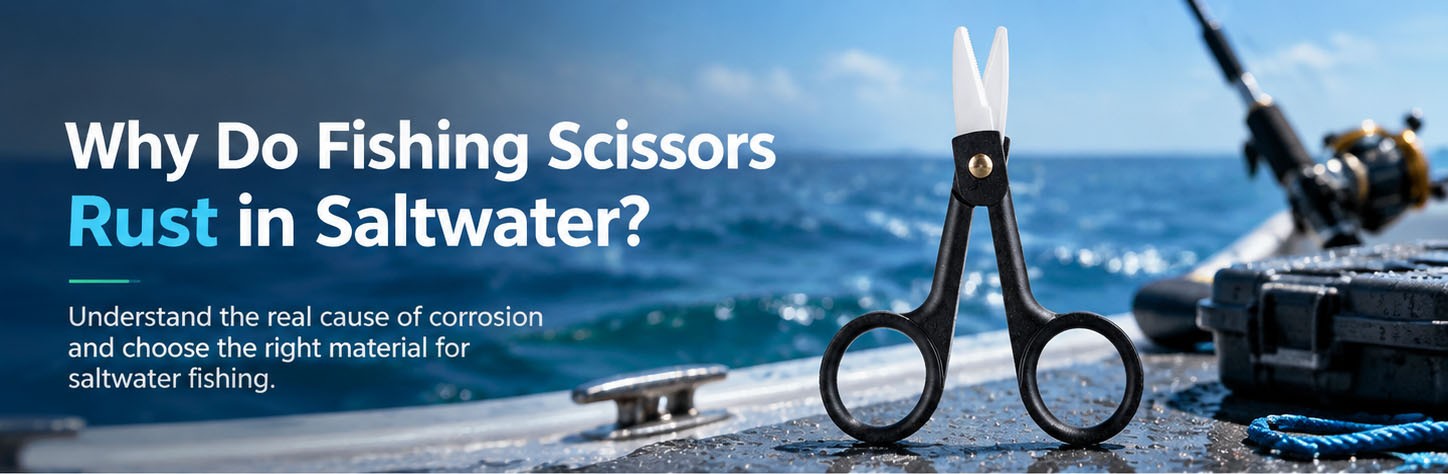
For many saltwater anglers, fishing scissors are one of the smallest tools in the tackle box, but they are also one of the tools that experience the harshest conditions.
A pair of scissors may look perfectly fine after a day of offshore fishing. However, after being stored in a wet tackle bag for several days, small rust spots can appear around the blade, pivot, or screws. Over time, the scissors may become harder to open, lose cutting performance, or even need replacement.
So why do fishing scissors rust in saltwater? Is it simply because the scissors are low quality? Or is there a deeper reason related to material selection and marine environments?
The answer is that saltwater creates a much more aggressive corrosion environment than freshwater. The combination of salt, moisture, oxygen, and repeated wet-dry cycles can gradually damage many traditional metal tools.
Understanding why corrosion happens is the first step to choosing better fishing scissors for saltwater applications.
Saltwater fishing creates unique challenges for small cutting tools. Unlike household scissors that stay in a dry environment, fishing scissors are exposed to seawater, salt spray, humidity, fish residue, and wet storage conditions.
Every fishing trip creates multiple opportunities for corrosion to start.
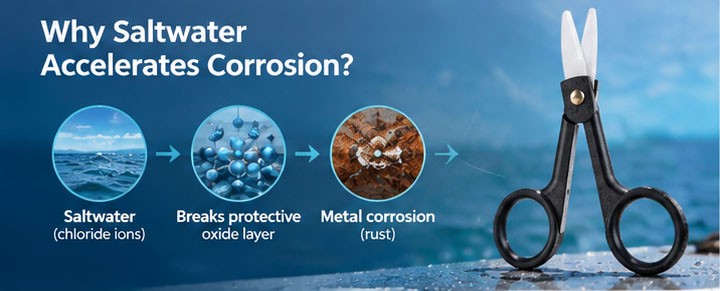
The main reason saltwater is highly corrosive is the presence of dissolved salts, especially chloride ions.
When saltwater contacts a metal surface, it can interfere with the protective layer that normally helps prevent corrosion. For many metals, this creates an electrochemical reaction where the metal gradually loses material and forms corrosion products commonly known as rust.
This process becomes faster when:
The tool remains wet for a long time
Salt residue is not removed after use
The surface has scratches or damaged protective coatings
The tool is stored in a humid tackle box
This is why a fishing scissor that performs well during the first few trips may start showing corrosion after repeated saltwater exposure.
Fishing scissors are constantly exposed to conditions that are difficult for metal tools.
During a typical saltwater fishing trip, scissors may come into contact with:
Saltwater splashes from waves
Wet fishing lines covered with seawater
Salt deposits inside tackle bags
High humidity on boats or coastal areas
Fish slime and organic residue
The problem is not only direct contact with seawater. A common situation is that anglers finish fishing, put their scissors back into a tackle box, and forget about them until the next trip.
The remaining moisture and salt particles continue affecting the tool even when it is no longer being used.
When anglers notice rust on fishing scissors, they often focus only on the cutting blade. However, corrosion can happen in several different areas of the tool.
For professional fishing accessory brands and distributors, this is an important point. Corrosion resistance is not only about choosing a blade material. The complete product construction matters.
The blade is the most important functional area of a fishing scissor.
Traditional metal blades can develop corrosion when their protective surface is damaged by:
Repeated cutting
Contact with abrasive fishing lines
Small scratches during use
Long-term salt exposure
Once corrosion begins on the cutting edge, it can affect cutting performance. A rough or damaged edge may require more force to cut fishing line and may create less consistent results.
One of the most overlooked areas of fishing scissors is the pivot mechanism.
Many scissors contain several small metal components, including:
Pivot screws
Washers
Springs
Internal fasteners
Even when the main blade uses corrosion-resistant steel, these smaller parts can become weak points if the material selection is not suitable for marine environments.
This is why evaluating a saltwater fishing scissor requires looking at the entire structure, not only the visible blade.
Another challenge is that some areas of scissors are difficult to clean completely.
Salt residue can remain around:
The blade connection area
The pivot mechanism
Small gaps between components
Over time, these hidden areas can affect smooth operation and shorten the service life of the tool.
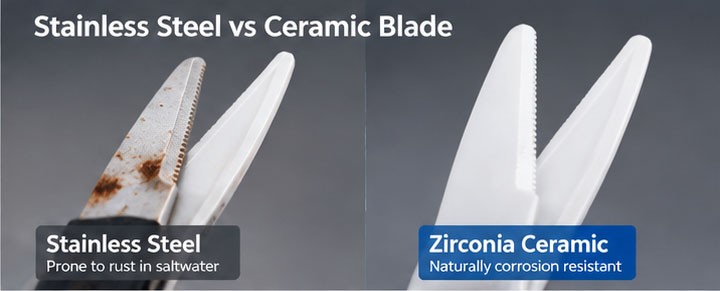
Many anglers choose stainless steel scissors because stainless steel is known for corrosion resistance. However, stainless steel does not mean completely immune to rust.
The term “stainless” means the material has improved resistance to staining and corrosion compared with ordinary steel. It does not mean the material cannot corrode under aggressive conditions.
Many anglers choose stainless steel fishing scissors because stainless steel has a reputation for durability and corrosion resistance. In many freshwater and general outdoor applications, stainless steel performs very well.
However, saltwater fishing creates a much more demanding environment. Stainless steel can resist corrosion, but it is not completely immune to corrosion.
The actual corrosion resistance depends on several factors, including the steel grade, surface treatment, manufacturing quality, and how the tool is maintained after use.
Stainless steel contains chromium, which helps create a passive oxide layer on the surface. This layer provides protection against corrosion under normal conditions.
However, saltwater environments can challenge this protective layer.
Chloride ions in seawater can attack the passive layer, especially when:
The surface has scratches or damage
Salt residue remains after fishing
The tool is stored while still wet
The environment has high humidity
For this reason, even stainless steel fishing scissors may eventually develop rust spots or corrosion marks after long-term saltwater exposure.
This does not mean stainless steel is a poor material. Stainless steel remains a practical choice for many fishing tools. The key point is that material selection should match the actual fishing environment.
Regardless of the material, proper maintenance can extend the service life of fishing scissors.
After saltwater fishing, anglers should:
Rinse scissors with fresh water
Remove salt residue from the blade and pivot area
Dry the scissors completely before storage
Keep the tool away from permanently wet environments
For occasional saltwater fishing, these steps may be enough to keep stainless steel scissors working well for a long time.
However, for frequent offshore fishing, commercial fishing applications, or fishing brands developing premium accessories, reducing corrosion risk through material selection becomes increasingly important.
Choosing a fishing scissor for saltwater use is not only about finding the sharpest blade. A good saltwater fishing scissor needs to balance corrosion resistance, cutting performance, durability, and practical handling.
For anglers and fishing accessory brands, several factors should be considered.
The blade material is one of the most important factors affecting long-term performance.
Traditional steel blades can provide excellent cutting ability, but they always require consideration of corrosion protection when used in marine environments.
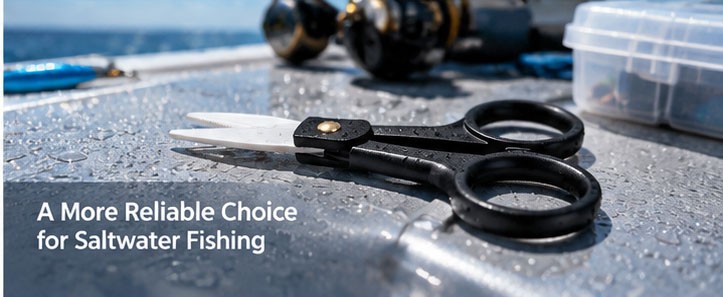
Zirconia ceramic is becoming an alternative material for fishing scissors because the ceramic blade itself does not rust like traditional metal blades.
Zirconia ceramic offers several characteristics that are valuable for saltwater applications:
Excellent corrosion resistance
High hardness and wear resistance
Stable cutting performance
Resistance to saltwater-related oxidation
For saltwater anglers, this means the cutting edge can maintain a cleaner surface without the same rust concerns associated with traditional metal blades.
Saltwater anglers often use scissors repeatedly during a single fishing trip.
Common tasks include:
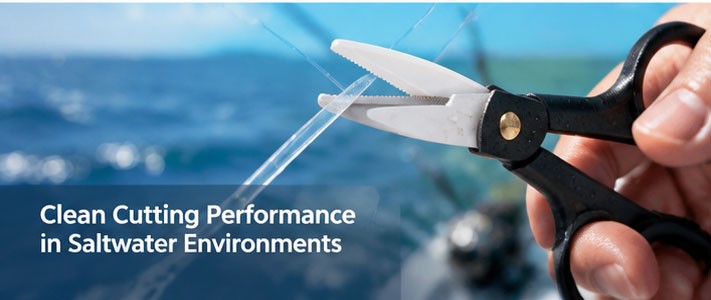
Cutting braided PE fishing line
Trimming fluorocarbon leaders
Preparing rigs
Removing damaged sections of fishing line
A suitable fishing scissor should provide consistent cutting performance instead of only being sharp when new.
Because zirconia ceramic has high hardness and excellent wear resistance, ceramic cutting tools can maintain their edge characteristics over extended use.
Saltwater fishing often involves wet hands, changing weather conditions, and limited working space on boats or kayaks.
A practical fishing scissor should also provide:
Comfortable grip
Easy operation with wet hands
Compact size for tackle storage
Reliable opening and closing performance
Material performance and user experience should work together. A corrosion-resistant blade is valuable, but the overall design determines whether the tool is convenient during real fishing situations.
When comparing stainless steel and zirconia ceramic fishing scissors, the goal is not to say that one material is suitable for every situation. Different materials provide different advantages.
| Feature | Stainless Steel Fishing Scissors | Zirconia Ceramic Fishing Scissors |
|---|---|---|
| Corrosion resistance | Good, depends on steel grade and maintenance | Excellent blade corrosion resistance |
| Saltwater exposure | Requires regular cleaning and care | Suitable for marine environments |
| Blade hardness | Depends on steel type | Very high hardness |
| Wear resistance | Good | Excellent |
| Maintenance requirements | Regular maintenance recommended | Blade maintenance is easier |
For anglers who fish occasionally in saltwater, high-quality stainless steel scissors with proper maintenance may be sufficient.
For frequent saltwater users, offshore anglers, and brands looking for premium fishing tools, zirconia ceramic provides a different approach by reducing corrosion concerns at the blade level.
For many saltwater fishing applications, ceramic fishing scissors offer several advantages because the blade material is naturally resistant to corrosion.
However, the biggest benefit is not simply “no rust.” The real advantage is creating a tool that is better matched to the conditions where corrosion is a constant challenge.
Saltwater fishing places unique demands on equipment. Choosing materials designed for these conditions can help improve reliability and reduce maintenance.
For saltwater anglers, the biggest challenge is not only finding a sharp fishing scissor. It is finding a tool that can continue performing after repeated exposure to a harsh marine environment.
This is where zirconia ceramic fishing scissors provide a different material approach.
Unlike traditional metal blades, zirconia ceramic does not undergo the same oxidation process that causes steel rust. This makes ceramic blades naturally suitable for applications where corrosion resistance is an important requirement.
For saltwater fishing scenarios such as offshore fishing, boat fishing, kayak fishing, and coastal fishing, ceramic blades can help reduce concerns related to blade corrosion and long-term storage.
For everyday anglers, a saltwater-ready fishing scissor can provide several practical advantages:
Less concern about blade rust after fishing trips
Reliable cutting performance for different fishing lines
Suitable for wet marine environments
Reduced maintenance compared with traditional metal blades
A fishing scissor is a small accessory, but it is often used at critical moments when preparing rigs, changing leaders, or solving problems on the water. A dependable cutting tool can improve the overall fishing experience.
For fishing tackle brands, wholesalers, and private-label sellers, material selection is also connected with product positioning and customer satisfaction.
A large number of fishing accessories on the market use similar stainless steel designs. Introducing zirconia ceramic fishing scissors can provide brands with a more differentiated product category.
Ceramic fishing tools can help brands develop products positioned around:
Premium saltwater fishing accessories
Corrosion-resistant fishing equipment
Long-lasting cutting tools
Specialized solutions for serious anglers
For distributors and retailers, products with clear material advantages can create stronger value communication compared with ordinary fishing scissors.
Many buyers focus only on sharpness when selecting fishing scissors. However, saltwater applications require a more complete evaluation.
A new fishing scissor may feel extremely sharp when first opened. However, long-term performance depends on more than the initial cutting ability.
Important factors include:
Blade material
Wear resistance
Corrosion resistance
Manufacturing quality
For saltwater use, a balanced design is often more valuable than temporary sharpness.
“Stainless steel” is a broad category. Different grades and manufacturing processes can result in different levels of corrosion resistance.
A fishing scissor designed for occasional freshwater use may not perform the same way in offshore saltwater conditions.
Buyers should consider the actual environment where the product will be used rather than selecting a material only by name.
As discussed earlier, corrosion can occur in pivot screws, springs, and other components.
A complete fishing scissor design should consider:
Blade material
Component quality
Assembly precision
Long-term durability
This is especially important for fishing brands developing products under their own labels.
Even corrosion-resistant fishing tools benefit from proper care. Good maintenance helps preserve performance and extends product life.
After saltwater fishing, consider the following steps:
Rinse with fresh water
Remove salt residue from the blade and moving parts after every trip.
Dry completely before storage
Avoid placing wet scissors directly into closed tackle boxes.
Check the pivot area regularly
Make sure the opening and closing action remains smooth.
Choose materials according to fishing conditions
For frequent marine use, corrosion-resistant materials can reduce long-term maintenance challenges.
MIDDIA focuses on developing ceramic cutting tools for professional fishing applications, combining zirconia ceramic technology with practical fishing tool design.
With ceramic manufacturing experience since 2010, MIDDIA understands the importance of material performance, precision processing, and application requirements for cutting tools.
MIDDIA ceramic fishing scissors are designed for users who need reliable cutting performance in demanding environments, including:
Saltwater fishing
Offshore fishing
Braid and fishing line cutting
Professional fishing accessory markets
For fishing tackle brands, distributors, and private-label partners, MIDDIA also provides OEM and ODM cooperation options, helping customers develop customized ceramic fishing tools for different markets.
Looking for Rust-Resistant Fishing Scissors for Your Brand?
Saltwater fishing puts cutting tools to the test. MIDDIA zirconia ceramic fishing scissors offer a corrosion-resistant blade alternative to conventional metal scissors, making them worth considering for saltwater fishing accessories and premium tackle product lines.
For fishing tackle brands, distributors, wholesalers, and private-label businesses, we offer OEM/ODM cooperation options to support different product and branding requirements. Contact our team to discuss ceramic fishing scissors samples, product specifications, logo customization, and your target order quantity.
Copyright © 2011-2026 custom ceramic blades, ceramic fishing scissors, ceramic box cutter, baby food scissors, zirconia blade manufacturer, MIDDIA MIDDIA. All Rights Reserved. XML Map
