Choosing fishing scissors for saltwater use is not as simple as looking for a blade that will not rust. Saltwater anglers need a tool that can cut fishing line cleanly, withstand regular exposure to a marine environment, and remain reliable after repeated use. For tackle brands and fishing accessory buyers, there is another consideration: the material must make sense for the intended market, product positioning, and long-term product value.
This is where the comparison between ceramic vs titanium fishing scissors becomes interesting. Both materials are associated with corrosion resistance, but they work differently and have different limitations. Zirconia ceramic blades offer high hardness and excellent resistance to rust, while titanium and titanium-coated metal scissors can offer a combination of corrosion resistance and the toughness associated with metal construction. The actual result depends on the materials used throughout the product, not just the name on the packaging.
So, are ceramic fishing scissors better than titanium fishing scissors for saltwater? The answer depends on what you expect the scissors to do. If cutting fishing line and minimizing blade corrosion are the main priorities, ceramic scissors deserve serious consideration. If impact resistance, metal construction, or broader utility is more important, a suitable titanium or titanium-coated design may be a better fit.
Understanding these differences can help individual anglers choose more carefully and help fishing tackle brands develop products that meet real customer needs.
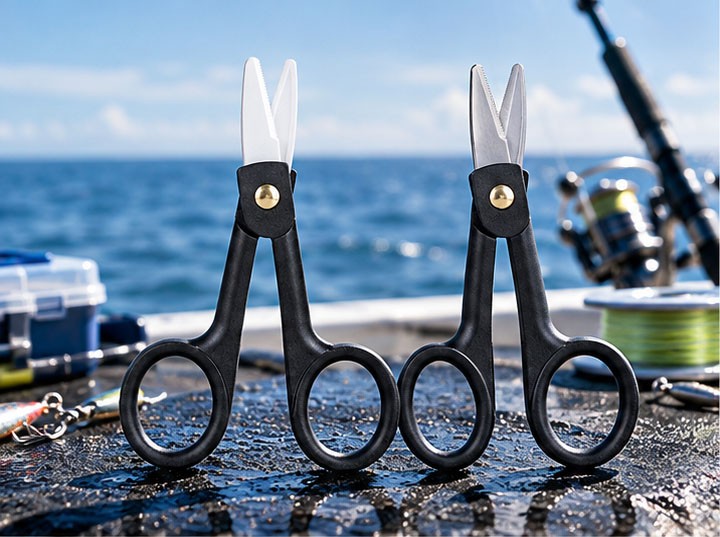
The first thing to understand is that ceramic and titanium describe different material categories. They should not be compared as if every product sold under either name has the same construction.
Many ceramic cutting tools use zirconia, also known as zirconium dioxide (ZrO₂). This engineered ceramic is valued for its high hardness, wear resistance, and resistance to corrosion. Unlike a conventional steel blade, a zirconia ceramic blade does not rust in the way iron-based metals can.
For fishing scissors, these properties are particularly relevant when the tool is frequently used around seawater, wet tackle, and humid storage conditions. The blade can maintain a clean, corrosion-resistant cutting surface without relying on a metallic blade material that may develop rust under unsuitable conditions.
However, high hardness does not mean that ceramic is indestructible. Zirconia is generally more susceptible to chipping or fracture under impact than a suitably designed metal blade. Dropping the scissors onto a hard surface, twisting the blades sideways, or attempting to cut an unsuitable hard material can damage the cutting edge.
This is why ceramic fishing scissors should be evaluated as precision cutting tools rather than heavy-duty multipurpose shears. Their performance depends on the quality of the ceramic blade, edge geometry, alignment, and the type of fishing line they are designed to cut.
The term "titanium fishing scissors" can refer to more than one type of product. Some scissors use titanium or a titanium alloy in particular structural components, while others use a metal blade with a titanium-containing surface coating. Titanium-coated stainless steel is a different construction from a blade made entirely from titanium or a titanium alloy.
This distinction matters because the base material still influences the finished product's performance. A coating may change the surface characteristics of a blade, but it does not automatically turn the underlying steel into solid titanium. The coating's thickness, adhesion, coverage, and resistance to wear also affect how the product performs over time.
Titanium and its alloys are well known for their corrosion resistance and useful strength-to-weight characteristics. Metal scissors may also tolerate certain forms of accidental impact better than ceramic blades, depending on the alloy, heat treatment, thickness, and overall design.
Still, it would be inaccurate to assume that every product labeled titanium is equally corrosion-resistant or durable. For saltwater applications, buyers should confirm the actual material specification, the construction of the cutting edges, and the materials used in the pivot, screws, springs, and other exposed components.
Saltwater fishing creates a demanding environment for small tools. Scissors may be exposed to seawater droplets, salt spray, wet hands, and tackle boxes that remain damp between trips. Corrosion can affect not only the cutting edge but also the pivot mechanism and other metal parts.
A ceramic blade has a clear advantage in one specific area: the ceramic cutting material itself does not rust like steel. A titanium-based product may also provide excellent corrosion resistance, but its performance depends on the precise construction and the materials used in the complete assembly.
Neither material name alone guarantees that the entire pair of scissors is corrosion-proof. A ceramic-bladed tool can still contain metal components that require attention, while a coated metal blade may behave differently if its coating becomes damaged. For this reason, it is better to compare complete products and their intended applications rather than make a decision based on material labels alone.
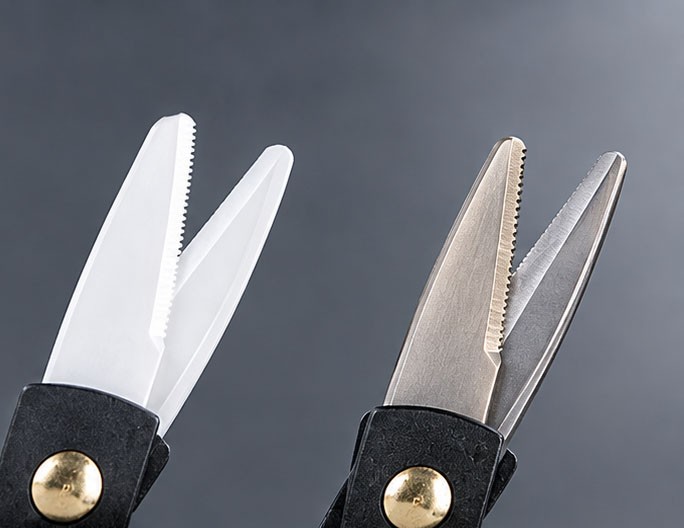
When comparing ceramic and titanium fishing scissors, it helps to separate the properties of the blade material from the performance of the finished tool. The following table summarizes the main considerations for saltwater anglers and fishing tackle buyers.
| Evaluation Factor | Zirconia Ceramic Blade | Titanium or Titanium-Coated Scissors |
|---|---|---|
| Blade corrosion | The ceramic blade does not rust like steel. | Depends on the actual material, base metal, and coating construction. |
| Hardness | Very high hardness and good wear resistance. | Varies with the alloy, base material, and blade treatment. |
| Impact resistance | More vulnerable to chipping or fracture under impact. | Metal construction generally offers greater tolerance for impact, depending on design. |
| Braided PE cutting | Depends on edge geometry, sharpness, and how effectively the blade engages the braid. | Also depends on blade geometry, edge condition, and the specific line being cut. |
| Maintenance | Low corrosion-related maintenance at the ceramic blade, although other components still need care. | Depends on the complete construction, including the pivot and any coating. |
| Product positioning | Suitable for products emphasizing ceramic cutting technology and blade corrosion resistance. | May suit products emphasizing metal construction, toughness, or a particular titanium-related feature. |
For the blade itself, zirconia ceramic has a straightforward advantage over ordinary steel: it does not rust in the conventional sense. This makes ceramic an attractive option for fishing scissors intended for regular use around seawater.
Titanium is also highly corrosion-resistant, and a properly specified titanium alloy can perform very well in marine environments. However, a titanium-coated steel blade should not be evaluated in exactly the same way as a solid titanium component. The underlying metal and the condition of the coating remain important.
There is no sound basis for claiming that every ceramic pair of scissors will outlast every titanium pair. A well-designed metal tool may provide excellent service, while a poorly assembled ceramic product may still have problems with alignment, hardware, or handling damage.
For a fair comparison, consider the actual blade material, the complete product construction, the intended exposure conditions, and any available test results from the manufacturer.
Impact resistance is one of the most important trade-offs to understand. Ceramic materials are hard, but hardness and toughness are not the same property. A hard ceramic edge can resist wear well while remaining more vulnerable to sudden impact or excessive sideways force.
Metal scissors generally have an advantage when accidental knocks, drops, or demanding handling are likely. The extent of that advantage depends on the metal, blade thickness, geometry, and overall construction. Titanium itself should not automatically be treated as a guarantee of superior cutting performance or durability in every design.
For anglers who mainly need a compact tool to trim fishing line, the limitations of ceramic may be manageable with sensible use. For users who expect one pair of scissors to handle a wide range of tasks, including operations outside the manufacturer's intended use, a suitable metal design may be more practical.
Blade longevity is more complicated than comparing hardness figures. A ceramic blade's high hardness can contribute to wear resistance, but actual cutting performance also depends on edge sharpness, edge geometry, manufacturing precision, and the material being cut.
The same is true of titanium-related products. A titanium-containing coating does not automatically make a blade sharper, and a titanium alloy is not necessarily the cutting material used at the edge. If the product uses a different metal as its cutting substrate, that substrate and its treatment will play a major role in the result.
For fishing scissors, a useful comparison should look at repeated cuts through the intended fishing lines, the consistency of the cut, and whether the blades continue to meet cleanly. Braided PE line, nylon monofilament, and fluorocarbon leaders place different demands on a cutting edge.
For manufacturers and private-label buyers, this is also why sample testing matters. Rather than relying on a material name or a general hardness claim, test the actual finished product using the line types, diameters, and conditions relevant to the target market.
A fishing tool may perform well in a shop or on a freshwater trip but face different conditions during a full day on the sea. Salt spray, repeated handling with wet hands, and storage in a damp tackle bag can all affect the condition of a pair of scissors. The best choice is therefore not determined by blade material alone.
Saltwater exposure is not always a single event. Fishing scissors may be exposed to small amounts of seawater many times, with salt residue remaining on the surface between uses. If the tool is stored before it has dried properly, moisture and salt can remain around joints and other hard-to-reach areas.
Zirconia ceramic blades offer an advantage because the blade material itself does not rust. For anglers who regularly trim line on a boat or near the shore, this can reduce one common concern associated with metal cutting edges.
Titanium and suitable titanium alloys also offer strong corrosion resistance. A titanium-coated steel product, however, should be evaluated according to its actual substrate, coating quality, and construction. A product's performance in saltwater depends on the complete assembly, not just the exposed blade surface.
In practical terms, buyers should look beyond the material name. The pivot, screws, springs, and any other exposed metal components may influence how smoothly the scissors operate after repeated marine use.
The ceramic blade itself does not need a conventional rust-prevention coating in the way an iron-based steel blade might. Zirconia is highly resistant to corrosion under ordinary fishing conditions, which is one reason it is used in specialized cutting tools.
However, a pair of ceramic fishing scissors is rarely made entirely from ceramic. Depending on the design, the product may include a metal pivot, fasteners, a spring, or other structural components. These parts can still require appropriate material selection and routine care.
This distinction is important for both users and product developers. Calling a product "ceramic" describes an important part of its construction, but it should not be taken to mean that every component is immune to corrosion or mechanical wear.
For MIDDIA and other ceramic cutting-tool suppliers, the practical product question is how the ceramic blade and the supporting hardware work together. Good blade performance matters, but reliable assembly and consistent product quality matter too.
Titanium itself is known for its corrosion resistance, particularly because it forms a stable protective oxide layer. Properly specified titanium components can be suitable for demanding marine environments. Nevertheless, the phrase "titanium scissors" does not always mean that the entire tool is made from titanium.
If the product uses titanium-coated stainless steel, the underlying steel remains part of the performance equation. The quality and coverage of the coating, the condition of the blade, and the corrosion resistance of other components should all be considered.
It is also important to distinguish rust from other forms of surface change or damage. A coated blade may show wear without the coating itself being the only factor affecting cutting performance, while a metal pivot may require cleaning even if the blade remains in good condition.
For buyers comparing products, ask the supplier to identify the actual material construction rather than relying on a short product title. This is particularly useful when developing a private-label fishing accessory where material claims will appear in product listings and packaging.
Neither ceramic nor titanium scissors should be treated as completely maintenance-free. After saltwater use, rinse the tool with fresh water when appropriate, remove salt and debris, and dry it thoroughly before storage. Pay attention to the pivot and any moving parts, since these areas may collect residue.
For ceramic scissors, avoid dropping the tool onto hard surfaces or applying sideways force to the blades. For metal or coated-metal scissors, inspect the blade surface and moving components for signs of wear, damage, or restricted movement.
These simple habits help keep the tool clean and functional. They also make it easier to identify problems before they affect the cutting experience.
Material selection is only one part of the cutting equation. Fishing lines differ in construction, flexibility, diameter, and surface characteristics. A pair of scissors that works well on thin monofilament may not perform equally well on tightly braided PE line or a thick fluorocarbon leader.
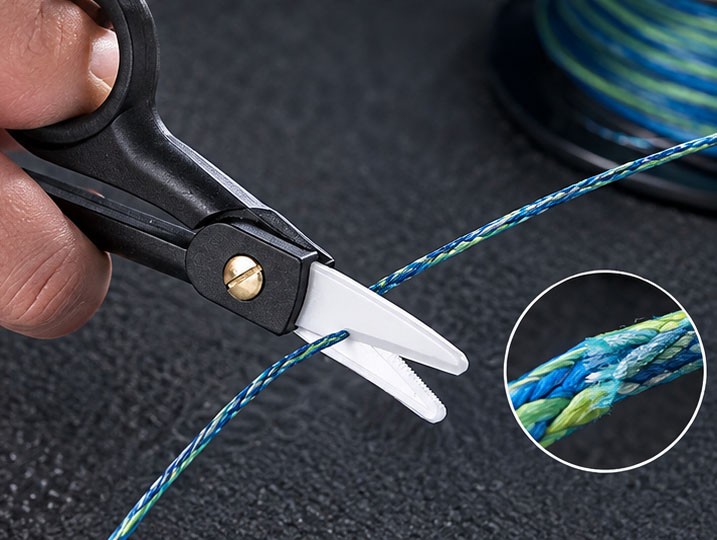
Braided PE line is made from multiple high-strength fibers woven together. Because the fibers are flexible, the line can flatten, move away from the cutting edge, or resist a clean cut if the blade cannot engage it properly.
For this application, edge geometry is especially important. A suitable serrated edge may help hold the braid in position, while precise blade alignment and sufficient sharpness help produce a cleaner cut. These characteristics can matter more than the broad material category alone.
A well-designed zirconia ceramic blade can be a useful option for cutting braided fishing line, provided the specific product is designed and tested for that purpose. Metal scissors can also cut PE line effectively when their edge design and sharpness are appropriate.
When comparing the two, test the actual line types and diameters used by the intended customer. Check whether the line is cut cleanly in one action, whether loose fibers remain, and whether performance is consistent over repeated cuts. Avoid assuming that every ceramic or titanium product will deliver the same result.
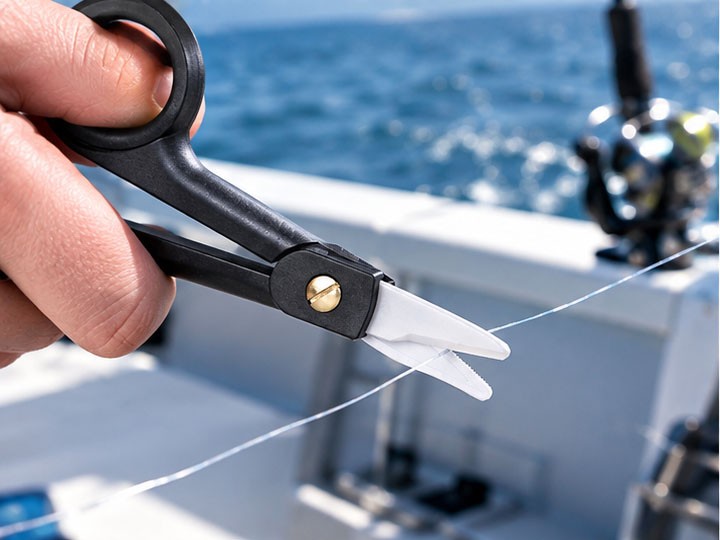
Nylon monofilament is a single continuous strand rather than a bundle of woven fibers. Its cutting behavior differs from braided PE, and the line may move if it is not held securely between the blades.
Both ceramic and suitable metal scissors can work well for monofilament. A clean cut depends on the condition of the cutting edges, blade alignment, the line diameter, and how the line is positioned. For thin monofilament, control and precision are often more useful than choosing a material based on a hardness specification alone.
Anglers who regularly prepare rigs or trim tag ends should look for scissors that can make consistent cuts without excessive pressure. For product developers, testing should include the monofilament diameters commonly used by the target market rather than relying on a single demonstration cut.
Fluorocarbon leaders are often selected for their abrasion resistance and other fishing characteristics. Depending on the diameter and construction, they can place different demands on a small pair of scissors than thin monofilament or braided PE line.
The key question is whether the scissors are designed for the intended leader diameter. A compact ceramic line cutter may perform well within its specified range, but it should not automatically be treated as a heavy-duty tool for thick leaders or hard materials.
For both ceramic and metal scissors, evaluate the cutting result using the actual fluorocarbon line. Check for clean separation, comfortable operation, and consistent blade contact. If the product is intended for a broad range of line diameters, those claims should be supported by practical testing.
Two scissors made from different materials may perform similarly if their edge geometry, alignment, and manufacturing quality are comparable. Conversely, two products using the same blade material may deliver noticeably different results.
For fishing-line cutting, useful design considerations include the blade angle, edge finish, blade overlap, serration pattern where applicable, and the stability of the pivot. These features influence how the line engages with the edge and how consistently the blades meet.
That is why a meaningful ceramic-versus-titanium comparison should focus on finished products rather than material names alone. For anglers, this means choosing a tool designed for their main fishing lines. For brands and distributors, it means testing the actual model before committing to a product range.
There is no single material that is best for every saltwater fishing application. The right choice depends on the type of cutting, the level of exposure to seawater, the expected handling conditions, and the product's price and positioning.
You want a cutting blade that does not rust like conventional steel.
Your main task is cutting fishing line rather than performing heavy-duty cutting or prying.
You value high blade hardness and wear resistance.
You want to explore ceramic cutting technology as a point of differentiation in a fishing accessory range.
You can follow the manufacturer's guidance on handling and avoid impacts that may chip or fracture the blade.
Ceramic scissors are worth considering when corrosion resistance at the cutting edge and fishing-line cutting performance are central requirements. Their suitability still depends on the specific design and the lines the tool is intended to cut.
You prefer a metal cutting tool with greater tolerance for certain forms of accidental impact.
You need a product designed for a wider range of tasks, provided those tasks are within its specifications.
You have confirmed the actual blade material and construction.
You want to compare a specific titanium or coated-metal product against ceramic alternatives using practical tests.
A titanium-related product may be an appropriate choice, but its advantages should be assessed at the model level. The word "titanium" alone does not establish cutting sharpness, coating durability, or the corrosion resistance of every component.
No. Ceramic offers a clear advantage in resistance to rust at the blade itself, while metal construction generally offers greater tolerance for impact. Both can be suitable for saltwater fishing when the product is designed for the intended application.
For anglers who mainly trim fishing line and want a corrosion-resistant cutting edge, ceramic scissors are a strong option to evaluate. For users who prioritize metal construction or need a broader range of cutting tasks, a suitable titanium or titanium-coated design may be more appropriate.
The most reliable way to decide is to compare complete products, confirm their material specifications, and test them with the fishing lines and conditions that matter most to you.
For fishing tackle brands, choosing between ceramic and titanium fishing scissors is not only a technical decision. The product must also fit the target market, offer a clear reason for customers to choose it, and meet the quality expectations associated with the brand.
A product that performs well in one fishing application may not be the best choice for another. Before selecting a material, buyers should identify the intended users, the fishing-line types involved, and the features that matter most to those customers.
Start with the customer rather than the material specification. A compact line cutter for recreational saltwater anglers has different requirements from a general-purpose fishing tool intended for frequent use in demanding conditions.
Consider whether the main application is braided PE line, nylon monofilament, fluorocarbon leaders, or a combination of these. Think about the typical line diameters, the frequency of use, and whether customers prioritize corrosion resistance, cutting precision, portability, or versatility.
For a private-label brand, these decisions also influence product positioning. A ceramic cutting tool may appeal to customers looking for an alternative to conventional metal blades, while a metal design may be more appropriate for a product range focused on impact tolerance and multipurpose use.
Material specifications are important, but they should be only one part of a supplier evaluation. Before approving a fishing scissors model, buyers should examine the finished product and confirm that it performs as expected.
Blade material and finish: Confirm the actual material used at the cutting edge and review the blade finish and manufacturing quality.
Cutting performance: Test the product on the intended PE braid, monofilament, and fluorocarbon line sizes.
Blade alignment: Check that the blades meet consistently and do not leave avoidable gaps that interfere with cutting.
Hardware and corrosion resistance: Review the pivot, fasteners, springs, and other exposed components for suitability in marine environments.
Handling and portability: Evaluate grip comfort, dimensions, carrying options, and any attachment or retention mechanism.
Quality consistency: Confirm that samples and production units are manufactured to the agreed specification.
Where corrosion resistance is a major selling point, buyers should also define the intended exposure conditions and ask what supporting test information is available. A general material claim should not be treated as proof of a specific service life.
The lowest quotation does not always represent the best sourcing decision. For brands, distributors, and wholesalers, the more useful question is whether the product offers the right combination of performance, consistency, customization, and cost for the intended market.
A sourcing review may include the following considerations:
Target retail positioning and the product's main point of differentiation.
Required specifications and the level of product customization.
Logo application, retail packaging, and SKU planning.
Minimum order quantities, production lead times, and repeat-order requirements.
Sample approval, quality-control procedures, and specification consistency.
Communication, technical support, and the supplier's ability to meet the agreed requirements.
These factors are especially important for private-label products. The goal is not simply to source scissors made from a particular material, but to develop a finished product that meets customer expectations and can be supplied consistently.
Fishing tackle brands may have different requirements for product appearance, branding, packaging, and intended use. Working directly with a manufacturer can make it easier to discuss these requirements before placing a production order.
Depending on the available model and the scope of the project, customization discussions may cover logo application, handle colors, packaging, and suitable blade configurations. Any changes to the product structure or cutting performance should be evaluated against the intended application and confirmed during sample review.
Before requesting a quotation, it helps to prepare a short product brief covering the target market, intended fishing-line types, preferred design, estimated order volume, branding requirements, and packaging expectations. This gives the supplier a clearer basis for discussing feasibility, pricing, and production arrangements.
For buyers comparing ceramic and titanium options, the same evaluation criteria should be applied to each sample. A fair comparison considers the complete product, not just the material name, and checks performance under conditions relevant to the intended customers.
MIDDIA focuses on zirconia ceramic cutting tools and related products, including ceramic fishing scissors designed for fishing-line cutting applications. For fishing tackle brands, distributors, wholesalers, and private-label sellers, ceramic scissors can provide an alternative to conventional metal-bladed line cutters.
The main material advantage is straightforward: a zirconia ceramic blade does not rust like steel. Its high hardness and wear resistance can also be useful characteristics in a precision cutting tool. At the same time, the finished product must be selected according to its intended line types, blade configuration, construction, and handling requirements.
MIDDIA can discuss OEM and ODM requirements for suitable products, including logo application, handle colors, and retail packaging, subject to the specifications and capabilities available for the selected model.
If you are developing a saltwater fishing accessory line, start by identifying the fishing-line types your customers use and the features that matter most in your target market. This makes it easier to determine whether a ceramic line cutter is a suitable fit for your product range.
Contact MIDDIA to discuss your ceramic fishing scissors project and share your target application, customization requirements, and expected order volume.
It depends on the intended use. Zirconia ceramic blades do not rust like steel and offer high hardness, while suitable titanium and metal designs can provide excellent corrosion resistance and greater tolerance for impact. Compare the complete product, including its hardware and cutting performance, before deciding.
Titanium and suitable titanium alloys are highly corrosion-resistant. However, products marketed as titanium scissors may use different materials and constructions. Titanium-coated steel should not be treated as identical to solid titanium, and the pivot and other metal components also matter.
Yes, ceramic scissors can cut braided PE line when the specific model has a suitable blade design and is intended for that application. Edge geometry, blade alignment, sharpness, and line diameter all influence the result. Check the manufacturer's specifications and test the product with the intended line.
Ceramic blades are generally more susceptible to chipping or fracture under impact than metal blades. Avoid dropping ceramic scissors, twisting the blades sideways, or using them to cut unsuitable hard materials. Metal construction may be more forgiving under certain handling conditions.
They can be a good option, particularly when corrosion resistance at the cutting edge is important. However, the rest of the tool may contain metal components that need cleaning and care. Rinse away salt residue when appropriate, dry the scissors thoroughly, and follow the manufacturer's maintenance instructions.
MIDDIA can discuss OEM and ODM requirements for suitable ceramic fishing scissors, including branding, handle colors, and packaging options, subject to the selected model and project requirements. Buyers should provide their target market, intended fishing-line applications, estimated order quantity, and customization needs when requesting a quotation.
Looking for an Alternative to Titanium Fishing Scissors?
Comparing ceramic and titanium fishing scissors for saltwater applications? MIDDIA zirconia ceramic fishing scissors offer a corrosion-resistant blade alternative for fishing-line cutting, combining high blade hardness with a material that does not rust like conventional steel.
For fishing tackle brands, distributors, wholesalers, and private-label businesses, we can discuss OEM/ODM customization options, including branding, handle colors, product specifications, and retail packaging. Contact MIDDIA to discuss your target market, sample requirements, and bulk order plans.
Copyright © 2011-2026 custom ceramic blades, ceramic fishing scissors, ceramic box cutter, baby food scissors, zirconia blade manufacturer, MIDDIA MIDDIA. All Rights Reserved. XML Map
