Welcome to Custom Ceramic Blades & Shears Manufacturer Middia website

What Are Ceramic Fishing Scissors? Complete Guide

Release time:2026-09-09click:9

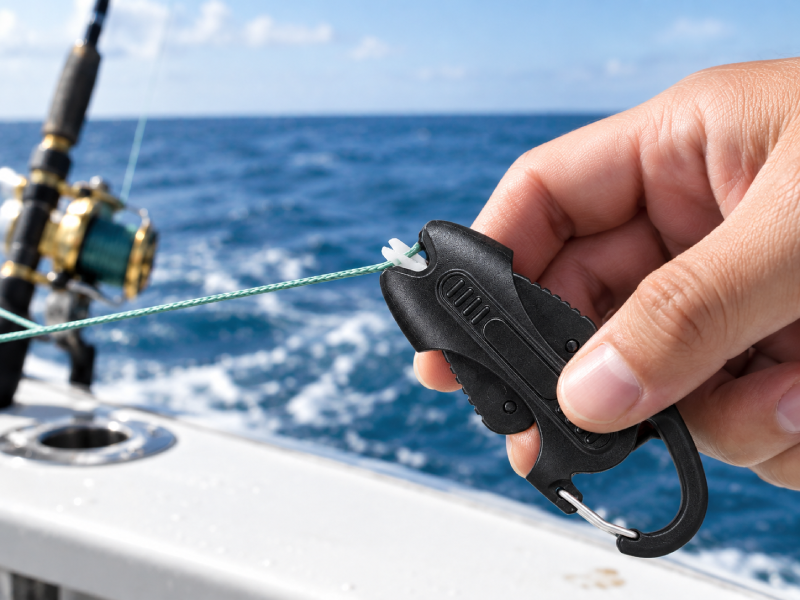
For fishing tackle brands, distributors, wholesalers, and private-label sellers, a small cutting tool can make a surprisingly large difference in a product lineup. Ceramic fishing scissors are designed specifically to address several weaknesses found in conventional metal fishing scissors, particularly when cutting braided PE fishing line in wet or saltwater environments.

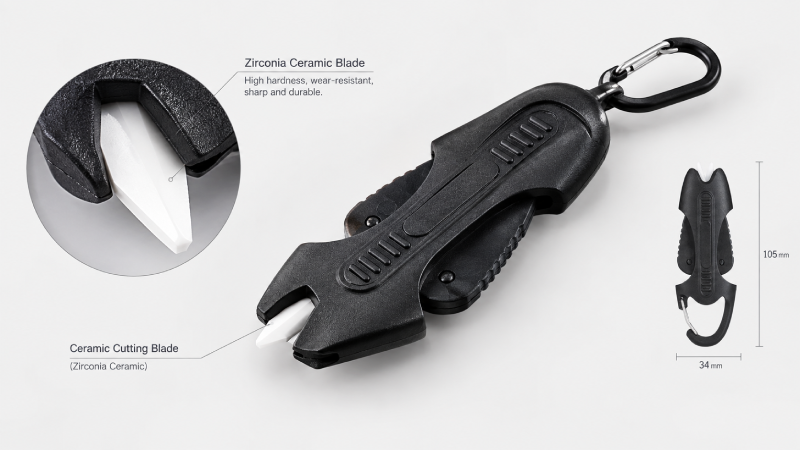
Unlike ordinary scissors that rely on stainless steel or other metal alloys, ceramic fishing scissors use a precision-engineered ceramic blade, commonly based on zirconia (ZrO2). The material provides high hardness, excellent wear resistance, and strong resistance to corrosion. These characteristics make ceramic blades particularly interesting for fishing applications where moisture, salt, and slippery synthetic fibers are part of everyday use.

For B2B buyers, however, the question is not simply whether ceramic is harder than steel. The more useful question is whether a ceramic cutting tool can deliver consistent performance, survive the intended environment, and provide enough product differentiation to justify adding it to a fishing tackle portfolio.

This guide explains how ceramic fishing scissors are made, how their material differs from conventional metal blades, what makes their design suitable for fishing applications, and what brands and sourcing companies should understand before developing their own products.

1. The Evolution of Fishing Line Cutting Tools

Fishing scissors are a relatively simple product on the surface. Two blades meet, pressure is applied, and the fishing line is cut. But anyone who has handled modern braided fishing line knows that the actual cutting process is not always that simple.

Traditional fishing scissors were generally developed around metal cutting edges. Stainless steel became a popular material because it offers a practical balance between hardness, toughness, manufacturing cost, and corrosion resistance. For general fishing applications, this combination works well.

The problem becomes more noticeable when the scissors are used repeatedly in demanding marine environments.

Saltwater, humidity, sand, sunscreen, fish slime, and repeated exposure to water all create a more aggressive operating environment than a typical household cutting application. Even corrosion-resistant metals still require appropriate material selection and maintenance. Small areas around pivots, joints, springs, screws, or damaged surfaces can become particularly vulnerable.

There is another problem that has become increasingly important as braided fishing lines have become more common: cutting slippery synthetic fibers cleanly.

Braided PE lines are thin, flexible, and highly resistant to abrasion. Instead of behaving like a rigid thread, the individual fibers can move, flatten, or spread when pressure is applied. A blade that is not sufficiently sharp, properly aligned, or appropriately shaped may push the line away instead of cutting through it cleanly.

The result is familiar to many anglers: repeated squeezing of the handles, a partially cut line, loose fibers, or a frayed end that needs to be trimmed again.

Why braided line changes the cutting requirement

Modern braided fishing lines can have extremely small diameters while maintaining considerable tensile strength. This combination is useful for fishing, but it creates a specific requirement for cutting tools.

A suitable line cutter needs to do more than simply have a sharp edge. The blades need to maintain contact with a very small target area, hold the line rather than allowing it to escape, and apply cutting force efficiently.

For this reason, blade geometry matters just as much as blade material.

A well-designed fishing scissors may use a fine cutting edge, closely matched blade surfaces, or micro-serrated geometry to improve grip on braided fibers. The ceramic material then contributes another layer of performance through its hardness and resistance to edge wear.

2. What Are Ceramic Fishing Scissors?

Ceramic fishing scissors are specialized cutting tools that use a ceramic blade rather than a conventional metal cutting edge. In higher-quality products, the ceramic blade is manufactured from engineered zirconia ceramic and processed through controlled molding, sintering, grinding, and finishing operations.

The term “ceramic” can sometimes create confusion because ceramic is a broad category of materials. Not every ceramic has the mechanical properties required for a precision cutting tool. Fishing scissors require a carefully formulated ceramic material with an appropriate balance between hardness, strength, toughness, and dimensional stability.

For precision cutting applications, zirconia ceramic is particularly useful because it combines high hardness with considerably better fracture toughness than many conventional technical ceramics.

2.1 Zirconia Ceramic: The Material Behind the Blade

Zirconia, chemically represented as ZrO2, is an advanced engineering ceramic used in a wide range of demanding applications. Its properties make it suitable for products where wear resistance, chemical stability, and dimensional consistency are important.

In a ceramic cutting blade, the material begins as a carefully prepared ceramic powder formulation. Depending on the manufacturing process and desired performance, additives and stabilizers can be incorporated to control the final microstructure and mechanical behavior.

The material is then formed into the required blade geometry before undergoing high-temperature sintering.

Sintering is a critical stage. The molded ceramic component is heated under controlled conditions so that the particles bond together and the material develops its final density and mechanical properties. Temperature profile, holding time, atmosphere, and material formulation can all influence the finished component.

This is one reason why simply describing a product as a “zirconia ceramic blade” does not tell a B2B buyer everything they need to know.

Two products can both use zirconia while producing noticeably different results because of differences in raw material quality, formulation, molding accuracy, sintering control, grinding, and edge finishing.

2.2 Precision Grinding Is Just as Important as the Ceramic Material

After sintering, the ceramic blade still requires precision processing. The cutting edge cannot simply be molded and placed directly into a pair of scissors if consistent cutting performance is expected.

Grinding and finishing determine important characteristics such as blade thickness, edge geometry, surface finish, dimensional accuracy, and the final interaction between the two blades.

This matters especially for fine braided fishing lines.

If the blade edges are not properly aligned, even a very hard ceramic material may not perform as expected. A small dimensional error can create excessive clearance between the blades, allowing the fishing line to move instead of being cleanly severed.

For OEM and private-label buyers, this is an important distinction. Product quality does not come from the ceramic material alone. It comes from the combination of material formulation, manufacturing process, blade geometry, precision grinding, assembly, and quality control.

2.3 Why Zirconia Is Suitable for Fishing Tools

Fishing tools operate in an environment where moisture and chemical exposure are unavoidable. This gives zirconia ceramic a practical advantage over many conventional metallic cutting materials.

Ceramic itself does not undergo the same electrochemical corrosion process associated with iron-based metals. As a result, a zirconia cutting edge does not develop conventional red rust when exposed to water or saltwater.

This characteristic is particularly valuable for saltwater fishing applications, where tools may be exposed to seawater repeatedly and then stored inside tackle boxes or bags while still carrying residual moisture.

The ceramic blade also does not require sharpening in the same way as many conventional metal blades. Instead, its high hardness and wear resistance are intended to help the cutting edge retain its geometry over extended use.

That does not mean ceramic scissors are maintenance-free in every respect. The pivot, spring, handle, fasteners, and other components still need to be designed with the intended environment in mind. A ceramic blade can be highly corrosion-resistant while other parts of the tool remain vulnerable if unsuitable materials are used.

3. Ceramic vs. Conventional Metal Blades: What Is Actually Different?

The most obvious difference between ceramic and stainless-steel fishing scissors is the blade material, but the practical differences go further than that.

Metal blades are valued for their toughness and resistance to impact. Stainless steel is also relatively easy to manufacture, grind, repair, and replace. These characteristics explain why it remains widely used across fishing tools.

Ceramic takes a different approach.

Instead of relying primarily on the toughness and ductility of a metal alloy, a zirconia ceramic blade is designed around high hardness, wear resistance, chemical stability, and edge retention. This makes it especially attractive for applications where the cutting edge must remain precise and where exposure to moisture or saltwater is a major concern.

There is therefore no simple rule that ceramic is “better” than stainless steel for every cutting task. The two materials have different engineering characteristics and are suited to different priorities.

For a fishing line cutter intended primarily for trimming braided PE line, leader materials, and similar synthetic fibers, ceramic can offer a compelling combination of properties. For applications involving heavy impact, bending, or rough utility use, the toughness of a metal blade may still be an important consideration.

3.1 Hardness and Wear Resistance

One of zirconia ceramic’s most important characteristics is its high hardness. A harder cutting edge is generally less susceptible to mechanical wear during repeated contact with abrasive materials.

For fishing scissors, this matters because braided line is made from high-performance synthetic fibers engineered to resist abrasion. A cutting edge that gradually loses its geometry can become less effective even when the blade still appears visually sharp.

Maintaining a stable edge geometry can therefore contribute to more consistent cutting performance over the usable life of the product.

3.2 Chemical Stability and Corrosion Resistance

Another major advantage of ceramic is its chemical stability.

When the cutting edge is made from zirconia, it does not rust like a conventional ferrous metal surface. This makes the material particularly attractive for marine applications, where repeated exposure to seawater is difficult to avoid.

For product developers, however, corrosion resistance should be evaluated at the product level, not just the blade level. A complete pair of scissors may contain multiple materials, including the pivot mechanism, screws, springs, pins, and handle components.

A responsible manufacturer should therefore evaluate the complete construction rather than treating the ceramic blade as the only corrosion-related component.

4. How the Blade Design Affects Fishing Line Cutting

Material alone does not determine whether a pair of fishing scissors will cut braided line well. Blade geometry, alignment, surface finish, and handle mechanics all contribute to the final result.

For fine PE braided line, one of the most useful design principles is to prevent the fibers from escaping between the blades.

This is where a micro-serrated edge can be useful. Small serrations can create additional contact points with the braided fibers and help hold the line in position while the blades close.

A smooth ceramic edge can also be effective when the blade geometry and blade alignment are properly engineered. The appropriate configuration depends on the intended line diameter, cutting application, and product design.

The handle design should also be considered. Fishing scissors are often operated with wet hands, gloves, or limited space inside a tackle box. An ergonomic handle with an appropriate grip surface can make repeated cutting more comfortable and reduce the chance of the tool slipping during use.

For OEM products, these seemingly small design details can become meaningful points of differentiation. A brand may choose a compact model for pocket or lanyard use, a larger ergonomic version for tackle kits, or a specialized configuration optimized for braided line.

5. Why the Ceramic Advantage Is Particularly Relevant to B2B Fishing Products

From a consumer perspective, the attraction of a ceramic blade may simply be “it stays sharp and does not rust.” For a B2B buyer, the value proposition is broader.

A fishing tackle brand is constantly looking for products that can solve a recognizable problem while offering a reason for customers to choose its product over a lower-priced alternative.

A ceramic cutting tool provides several potential positioning angles at the same time:

  • Corrosion-resistant cutting performance for marine environments

  • Specialized cutting capability for braided PE line

  • Premium material positioning

  • Compact and lightweight fishing accessory design

  • Potential for private-label branding

  • Easy integration into fishing tackle and line bundles

This is particularly relevant to fishing line brands. A premium PE line can be sold with a purpose-designed cutting tool as part of a more complete product experience. Instead of competing only on the price of a spool of line, the brand can create a more differentiated package around the fishing application.

Distributors and wholesalers can use the same concept when building accessory portfolios. A small, lightweight cutting tool takes relatively little shelf or warehouse space, yet it can serve as a practical add-on product for anglers who regularly use braided fishing line.

For Amazon and other e-commerce sellers, the opportunity is slightly different. The product can be positioned as a standalone fishing accessory or combined with complementary items such as a lanyard, protective sheath, or tackle accessory kit.

The important point is that ceramic is not valuable simply because it sounds like an advanced material. Its commercial value comes from connecting the material properties to a real fishing problem: clean cutting performance in a wet, corrosive environment.

That connection between engineering and application is what makes ceramic cutting technology worth considering for a professional fishing tool portfolio.

6. Key Advantages of Ceramic Fishing Scissors

The value of ceramic fishing scissors becomes clearer when the material properties are connected to actual fishing conditions. A ceramic blade is not simply a different-looking alternative to stainless steel. Its purpose is to address specific performance requirements, especially corrosion resistance, edge stability, and clean cutting of synthetic fishing lines.

For fishing tackle manufacturers and distributors, these characteristics can also create a more clearly differentiated product position. Instead of offering another generic pair of metal scissors, a brand can develop a tool around a specific user problem and application.

6.1 Rust-Free Ceramic Cutting Edge

One of the strongest reasons to consider ceramic for fishing applications is its resistance to conventional rust and corrosion.

Saltwater is particularly demanding on metal components. Dissolved salts increase the conductivity of water and can accelerate electrochemical corrosion processes. Fishing tools are repeatedly exposed to this environment during boat fishing, shore fishing, kayak fishing, and other marine activities.

A zirconia ceramic cutting edge does not rust in the same manner as an iron-containing metal blade. This gives ceramic an obvious advantage when the cutting edge is frequently exposed to seawater.

For an angler, this means less concern about the cutting edge developing visible rust after repeated use around saltwater. For a fishing tackle brand, it provides a clear product benefit that can be communicated without relying solely on aesthetics.

However, B2B buyers should distinguish between the ceramic blade and the complete scissors assembly.

A pair of scissors may include a pivot pin, spring, screw, washer, or other metal components. If these parts are made from unsuitable materials, corrosion can still occur even when the blade itself is highly corrosion-resistant.

For this reason, a properly designed marine-oriented product should consider corrosion resistance throughout the construction. Stainless steel components, appropriate surface treatments, and suitable assembly methods can complement the ceramic blade and improve the overall durability of the tool.

6.2 Clean Cutting of Braided PE Line

For many fishing applications, the ability to cut braided line cleanly is more important than simply having a hard blade.

Braided PE line is manufactured from high-strength polyethylene fibers woven into a compact structure. Its low diameter, flexibility, and abrasion resistance make it excellent for fishing, but these same properties can make it difficult to cut with an ordinary pair of scissors.

When a conventional blade becomes dull, the line may slide toward the gap between the blades instead of being severed immediately. The user may need to squeeze harder or make several cutting attempts. The resulting end can also become uneven or visibly frayed.

A properly engineered ceramic blade can provide a very fine and stable cutting edge. When combined with accurate blade alignment and suitable edge geometry, this allows the tool to engage the braided fibers more effectively.

For models using micro-serrated edges, the serrations can help grip the braid and reduce the tendency of the line to slide away as the handles close.

This is why product development should focus on the complete cutting system rather than advertising hardness alone. A high-hardness blade with poor alignment is not automatically a high-performance fishing line cutter.

For manufacturers, this distinction is important when evaluating samples from different suppliers. The correct comparison should include actual cutting tests on the line types and diameters the finished product is expected to handle.

6.3 High Hardness and Edge Retention

Another important characteristic of zirconia ceramic is its high hardness and resistance to wear.

Every cutting edge changes gradually during use. Repeated contact between the blade and cutting material creates mechanical wear, and the microscopic geometry of the edge can become less effective over time.

Because zirconia ceramic is significantly harder than many conventional metal cutting materials, it can maintain its edge geometry well under suitable operating conditions.

This does not mean that a ceramic blade is indestructible or that it will remain equally sharp under every possible use. Ceramic has a different failure mode from ductile metals. Excessive impact, twisting, dropping, or using the scissors on materials outside their intended application can damage a ceramic edge.

The practical advantage is therefore best described as long-term edge stability under appropriate cutting conditions.

For professional fishing tools, that can reduce the frequency with which users need to replace or sharpen the cutting tool. For distributors and brands, it can contribute to a stronger perception of product quality and a more premium position in the market.

6.4 Lightweight Construction

Weight is another consideration that is sometimes overlooked when developing fishing accessories.

Fishing tools are often carried for hours. They may be attached to a fishing vest, belt, lanyard, tackle bag, kayak, or boat storage system. A cutting tool that adds unnecessary weight is not ideal for every application.

Ceramic blades can contribute to a lightweight tool design, particularly when combined with an appropriately engineered polymer handle.

This makes compact ceramic scissors suitable for applications where portability matters. A small pair can be kept inside a tackle box or attached to a lanyard so that the angler can reach it quickly when changing leaders, trimming knots, or preparing a rig.

For product developers, compact dimensions also create opportunities for packaging and product bundling. A lightweight accessory can be added to a fishing line kit without significantly increasing shipping volume or package weight.

6.5 Low-Maintenance Cutting Performance

Fishing equipment is rarely used in a clean and dry environment. Tools may come into contact with saltwater, freshwater, sand, dust, bait residue, and other contaminants.

A ceramic cutting edge does not require the same rust-prevention treatment as a conventional carbon-steel edge. It can therefore simplify routine care for the user.

That said, “low maintenance” should not be interpreted as “no maintenance.” The scissors should still be rinsed when exposed to seawater, dried appropriately, and kept free of debris around the pivot and blade interface.

Proper care is especially important for the mechanical components of the scissors. Even when the ceramic blade itself is highly resistant to corrosion, the pivot mechanism still needs to operate smoothly for the tool to perform consistently.

7. Ceramic Fishing Scissors vs. Stainless Steel: Choosing the Right Material

When evaluating a new fishing tool, B2B buyers often compare ceramic with stainless steel first. That comparison is useful, but it should be made according to the intended application rather than a simple “better or worse” ranking.

Stainless steel remains an excellent material for many fishing tools. It offers good toughness, relatively straightforward processing, and strong resistance to corrosion when the appropriate grade and surface condition are selected.

Ceramic has a different performance profile. It prioritizes hardness, wear resistance, chemical stability, and edge retention while requiring more careful consideration of impact resistance and manufacturing precision.

The following comparison provides a practical starting point for product developers:

Performance FactorZirconia CeramicStainless Steel
Rust resistanceExcellent at the ceramic bladeDepends on stainless-steel grade and surface condition
Saltwater suitabilityExcellent for the ceramic cutting edgeGood with suitable grade and maintenance
HardnessVery highLower than engineering ceramics
Edge wear resistanceExcellent under suitable useGood, depending on alloy and heat treatment
WeightSuitable for lightweight tool designsGenerally higher blade density
Impact toleranceRequires careful handlingGenerally more tolerant of impact and bending
MaintenanceLow for the ceramic edgeMore attention may be required in marine environments
Manufacturing requirementsRequires controlled ceramic processing and precision grindingWell-established metal machining and finishing processes
Typical positioningPremium and specialized cutting applicationsGeneral-purpose and broad fishing applications

The key takeaway is that ceramic is not universally superior to stainless steel. Instead, it is particularly attractive where corrosion resistance, hardness, edge stability, lightweight construction, and specialized line cutting are important.

That distinction is useful for B2B product planning. A distributor may want both materials in its portfolio rather than replacing one with the other. Stainless steel can serve general-purpose applications, while ceramic can occupy a more specialized or premium segment.

8. What Can Ceramic Fishing Scissors Cut?

The cutting capability of a pair of fishing scissors depends on blade geometry, edge configuration, blade thickness, handle mechanics, and the specific material being cut. Therefore, a manufacturer should define the intended cutting range before selecting the blade design.

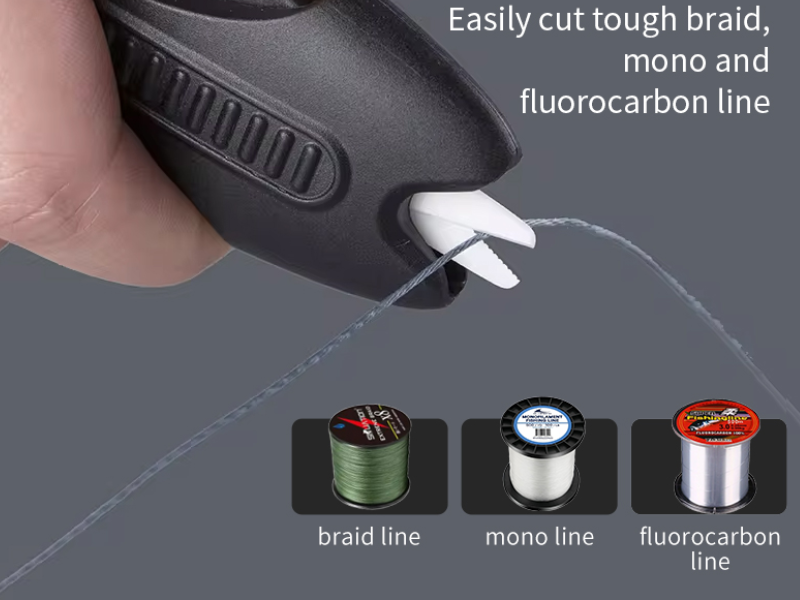
For fishing applications, ceramic blades are particularly suitable for many synthetic fishing lines and fine cutting tasks.

MaterialTypical SuitabilityCommon Application
Braided PE lineExcellent with suitable blade designLine trimming and rig preparation
Dyneema-type braided lineExcellent with appropriate modelHigh-performance fishing applications
FluorocarbonGood, depending on diameter and blade designLeader preparation
MonofilamentGoodGeneral fishing line cutting
Fishing line tags and fine synthetic materialsExcellentTackle assembly and finishing
Thick rope or heavy utility materialsModel dependentSpecialized utility applications

For braided PE line, the interaction between the blade and the fibers is particularly important. A blade that holds the braid securely while concentrating cutting force along a narrow edge can produce a much cleaner result than a blade that allows the braid to slip.

For this reason, B2B buyers should avoid evaluating a product solely by its stated blade material. A proper product test should use the actual line types, diameters, and cutting conditions expected in the target market.

8.1 Cutting Micro Braided Lines

Very thin braided lines present a unique challenge because there is little material for the blades to capture. The line can easily move laterally as the scissors close.

Fine blade alignment and an appropriate cutting edge can make a significant difference in this application. Micro-serrated edges may provide additional grip, while a finely finished smooth edge may be preferred for certain product configurations.

For a fishing tackle brand, this can also become a useful product specification. Rather than simply stating “sharp scissors,” the product can be positioned around a defined cutting application such as precision trimming of thin braided PE line.

8.2 Cutting Fluorocarbon and Monofilament

Fluorocarbon and monofilament behave differently from braided line. They are generally more uniform and less prone to separating into multiple fibers, but their cutting resistance increases with diameter.

A compact pair of ceramic scissors may perform very well on fine and medium-diameter lines, while thicker materials may require a larger blade and stronger handle mechanism.

This is why product specifications should clearly define the intended cutting range rather than suggesting that one model is suitable for every type of fishing line.

9. Application Scenarios for Ceramic Fishing Scissors

The best application for ceramic cutting tools is not limited to one style of fishing. Their corrosion resistance and compact design make them useful across several fishing environments, while their specialized cutting performance creates opportunities for fishing accessory brands.

9.1 Saltwater Fishing

Saltwater fishing is one of the clearest applications for ceramic cutting tools.

Whether the angler is fishing from a boat, kayak, pier, or shoreline, exposure to saltwater is difficult to avoid. A tool carried in a tackle box may become wet repeatedly, and salt residue can remain on the surface after the water evaporates.

A ceramic cutting edge eliminates conventional rust as a concern for the blade itself. This can be particularly attractive for anglers who fish in marine environments frequently.

For brands targeting saltwater tackle markets, corrosion resistance can therefore become a central part of the product positioning rather than a secondary specification.

9.2 Lure Fishing

Lure fishing often requires frequent line adjustments. Anglers may need to trim excess line after tying knots, replace leaders, or make quick changes to a rig while standing beside the water.

A compact pair of scissors that can cut braided PE line cleanly is convenient in these situations. The tool can be stored inside a tackle box, attached to a lanyard, or integrated into a larger fishing tool kit.

Its small size also makes it suitable for product bundles where space and shipping weight need to be controlled.

9.3 Boat and Kayak Fishing

On a boat or kayak, tools need to be compact, accessible, and resistant to the environment around them.

A fishing tool may be exposed to spray, rain, wet hands, and direct contact with seawater. In these conditions, a corrosion-resistant cutting edge offers a practical advantage.

For kayak fishing in particular, compact equipment is valuable because storage space is limited. A lightweight cutting tool can be positioned within easy reach without taking up significant space.

9.4 Shore Fishing

Shore anglers also benefit from compact line-cutting tools. A fisherman walking along a coastline may carry only a small tackle bag or vest rather than a full equipment case.

In this environment, a lightweight pair of scissors attached to a lanyard can provide quick access while reducing the need to carry larger tools.

9.5 Fishing Tackle and Line Preparation

Ceramic scissors can also be used during tackle preparation before reaching the water.

Fishing shops, tackle assembly operations, and serious anglers may need to trim braided line, leader material, tags, or other synthetic components repeatedly. Consistent cutting performance can improve both efficiency and the appearance of finished rigs.

For B2B customers, this expands the product's potential beyond the traditional “fishing accessory” category. It can become part of a broader tackle preparation or fishing tool system.

10. Why Ceramic Fishing Scissors Are a Useful Product for B2B Brands

For a fishing tackle manufacturer or distributor, product performance is only one part of the sourcing decision. A product also needs to make commercial sense. It should have a clear application, a recognizable selling point, reasonable production economics, and enough flexibility to fit the brand's existing product strategy.

This is where ceramic fishing scissors become particularly interesting as a B2B product category.

A conventional pair of fishing scissors can be difficult to differentiate. Many products have similar shapes, similar materials, and similar basic functions. Competing primarily on price can quickly turn a simple accessory into a low-margin commodity.

A ceramic cutting tool offers a different positioning opportunity. The combination of zirconia ceramic, corrosion resistance, specialized braided-line cutting performance, and lightweight construction gives brands several product features that can be communicated to customers in practical terms.

10.1 Premium Product Positioning

Ceramic is already associated with precision cutting applications in a number of industries. Using an engineered ceramic blade in a fishing tool can therefore create a stronger perceived value than an ordinary commodity scissors design.

For fishing tackle brands, this does not mean simply putting the word “ceramic” on the packaging. The material needs to be connected to a meaningful benefit.

For example:

  • Zirconia ceramic blade — communicates the material technology.

  • Rust-free cutting edge — connects the material to saltwater use.

  • Designed for braided PE line — identifies the specific application.

  • Long-lasting edge performance — communicates the value of high hardness and wear resistance.

This type of positioning allows a brand to build a product around performance rather than competing only on appearance or unit price.

10.2 Fishing Line Bundles

Fishing line manufacturers have another interesting opportunity: bundling.

A premium PE braided line can be paired with a compact line-cutting tool as part of a promotional package, starter kit, or premium tackle set. The scissors do not have to compete directly with the fishing line for attention. Instead, they reinforce the overall product experience.

For example, a fishing line brand could develop a package containing:

  • Premium braided PE fishing line

  • Compact ceramic line scissors

  • Line or leader accessories

  • Small protective sheath

  • Branded packaging

The exact bundle depends on the target market, but the concept is straightforward: combine products that solve problems during the same fishing activity.

10.3 Fishing Tool Kits

Distributors and wholesalers can also incorporate ceramic scissors into broader fishing tool kits.

A compact kit might include scissors, pliers, a line cutter, hook-related tools, a lanyard, or other tackle accessories. In this context, the scissors become one component of a higher-value package instead of a standalone low-price item.

This can create additional opportunities for private-label products, especially when the manufacturer can provide coordinated colors, logo placement, packaging, and multiple tool configurations.

10.4 Private-Label and E-Commerce Opportunities

For Amazon sellers and other e-commerce operators, differentiation is often difficult when the same generic product is available from multiple suppliers.

A private-label ceramic fishing tool can provide more room for product positioning. A seller can develop a specific combination of handle color, blade configuration, packaging, logo, and accessory bundle instead of listing an indistinguishable factory-standard product.

Packaging is particularly important in this market. A compact product with professional retail packaging can be sold as a standalone fishing accessory, while the same basic tool can be packaged as part of a premium tackle kit.

For B2B sourcing teams, the question should therefore not only be “What is the unit price?” It should also be:

  • Can the product be differentiated?

  • Can the supplier support customization?

  • Can packaging be adapted to the target market?

  • Can samples be tested before mass production?

  • Can the supplier maintain consistent quality at larger volumes?

11. What Should B2B Buyers Check When Sourcing Ceramic Fishing Scissors?

Choosing a ceramic fishing scissors manufacturer should involve more than comparing catalog photographs and quotations. The appearance of a finished tool can be easy to reproduce, while the underlying ceramic processing, blade precision, assembly quality, and quality-control system are much harder to evaluate from a product listing.

A professional sourcing process should therefore look at both the blade and the complete tool.

11.1 Ceramic Material Quality

The first question is what type of ceramic is actually being used.

For precision cutting applications, zirconia is commonly selected because it provides a useful combination of hardness, wear resistance, and toughness compared with many other technical ceramics.

However, “zirconia” alone is not a sufficient quality specification. Raw material purity, formulation, stabilizer system, particle characteristics, forming method, and sintering conditions can all influence the final performance.

B2B buyers should therefore ask manufacturers for appropriate material specifications and understand which characteristics are controlled during production.

11.2 Blade Precision and Dimensional Consistency

Precision is particularly important for fishing scissors because the cutting action depends on the relationship between two moving blades.

If the blade geometry varies too much from one production batch to another, the cutting performance can become inconsistent. One sample may cut braided line cleanly while another requires significantly more pressure.

Manufacturers should therefore control important dimensions during molding, sintering, grinding, and final assembly.

For OEM customers, this becomes even more important when thousands or tens of thousands of units are produced under the same private label. Consistency is part of the product specification.

11.3 Edge Quality and Cutting Performance

A good sourcing evaluation should include practical cutting tests.

Rather than asking only whether a sample is “sharp,” test it against the materials that matter to the intended market.

For example, a fishing line brand may want to test:

  • Fine braided PE line

  • Medium-diameter braided line

  • Fluorocarbon leader

  • Monofilament line

The test should examine whether the line is cut cleanly, whether the braid slips between the blades, how much hand force is required, and whether the cutting result remains consistent after repeated cycles.

This type of test provides much more useful information than judging sharpness by visual inspection alone.

11.4 Chipping and Fracture Resistance

One of the most common concerns about ceramic cutting tools is whether the blade is too brittle.

The concern is understandable. Ceramic materials behave differently from ductile metals. A stainless-steel blade may bend or deform under excessive force, whereas an improperly designed or mishandled ceramic component can chip or fracture.

This is why ceramic blade manufacturing requires careful control of material formulation, density, grinding, edge geometry, and finishing.

Edge design also matters. An extremely thin edge may provide excellent initial sharpness but may not provide the desired balance between cutting performance and durability. The appropriate geometry depends on the intended application.

For B2B buyers, the right question is therefore not simply:

“Is ceramic fragile?”

A better question is:

“Has the manufacturer engineered the ceramic blade for the intended cutting conditions and controlled the production process consistently?”

This distinction is important when comparing suppliers.

11.5 Handle Design and Ergonomics

The handle is sometimes treated as a secondary component because the blade receives most of the attention. In actual use, however, handle design directly affects cutting control.

A fishing scissors handle should provide sufficient grip when the user's hands are wet. Rounded edges, appropriate finger openings, anti-slip surfaces, and balanced proportions can all improve usability.

For different target markets, the preferred design may also vary. A compact tool intended for a lanyard may prioritize small dimensions and low weight, while a professional tackle kit may require a larger handle for repeated use.

OEM manufacturers should be able to adjust these details without compromising the fundamental blade geometry.

11.6 Corrosion Resistance of Non-Ceramic Components

This is an important point that is sometimes overlooked in product specifications.

The ceramic blade itself may be highly resistant to corrosion, but the complete scissors can still contain metal components. These may include the pivot, spring, screws, pins, or washers.

For products intended for saltwater fishing, the material selection of these components should therefore be reviewed as part of the complete product design.

Depending on the product configuration and target price, manufacturers may select corrosion-resistant stainless-steel components or other suitable materials and surface treatments.

A B2B buyer should always evaluate the complete assembly rather than relying on the word “ceramic” as a guarantee of total corrosion resistance.

11.7 Quality Control and Inspection

Quality control is one of the most important differences between a specialized manufacturer and a trading supplier that simply sources finished goods.

For ceramic cutting tools, inspection can cover several stages:

  • Incoming ceramic raw material inspection

  • Blade dimensional inspection

  • Surface and edge inspection

  • Blade alignment inspection

  • Assembly inspection

  • Cutting performance testing

  • Appearance inspection

  • Packaging inspection

The exact inspection plan should depend on the product and customer's specification. The important point is that quality should be controlled systematically rather than relying entirely on final visual inspection.

11.8 MOQ, Sampling, and Production Lead Time

For a B2B buyer, commercial flexibility can be just as important as technical capability.

New fishing brands may want to test a product with a relatively small initial order before investing in larger inventory. Established distributors, on the other hand, may require stable production capacity for recurring orders.

A suitable supplier should be able to discuss:

  • Sample availability

  • Sample development costs

  • MOQ requirements

  • Bulk production lead time

  • Packaging options

  • Logo customization

  • Repeat-order consistency

These factors can have a direct effect on the commercial feasibility of a private-label fishing tool.

12. OEM and Private Label Ceramic Fishing Scissors

For fishing tackle brands, one of the biggest advantages of working directly with a manufacturer is the ability to develop a product around the brand rather than simply selecting an off-the-shelf item.

OEM and ODM programs can cover different levels of customization, from a simple logo application to a completely new product design.

12.1 Custom Logo and Branding

Logo customization is the most straightforward option.

Depending on the handle material and product design, branding may be applied through methods such as laser engraving, printing, or other suitable marking processes.

The appropriate method depends on the surface, logo complexity, color requirements, and expected durability.

For brands selling through retail stores or e-commerce channels, consistent branding across the scissors, packaging, and related fishing accessories can create a more professional product presentation.

12.2 Custom Handle Colors

Handle color is another relatively simple but effective customization option.

Fishing brands often have established visual identities. Matching the handle color to the brand's existing product range can make a new tool look like a natural part of the portfolio rather than a generic accessory.

For larger OEM projects, manufacturers may be able to work with defined color specifications or Pantone references, subject to material and production limitations.

12.3 Custom Blade Configurations

More advanced OEM projects can involve blade configuration.

Depending on the intended application, buyers may evaluate differences in blade length, edge geometry, serration pattern, handle dimensions, or overall scissors size.

A product intended specifically for micro-braided PE line may require a different design priority from a general-purpose fishing scissors intended for several types of line.

For this reason, manufacturers should evaluate the intended cutting application before finalizing the design.

12.4 Retail and E-Commerce Packaging

Packaging should be considered at the beginning of an OEM project rather than after the product itself has been finalized.

Retail fishing stores may require hanging displays, while e-commerce sellers may prefer compact boxes that protect the scissors and provide enough surface area for product information.

Common options can include:

  • Clamshell packaging

  • Blister card packaging

  • Compact paper boxes

  • Printed gift boxes

  • Custom inserts

  • Protective blade sheaths

Packaging can also be designed around the intended sales channel. A retail package needs strong shelf visibility, while an Amazon-focused product may prioritize compact dimensions, protection, branding, and efficient shipping.

12.5 OEM Development and Sampling

A good OEM process should allow the buyer to evaluate samples before committing to mass production.

A typical development process may include:

  1. Define the intended application and target market.

  2. Select the basic scissors configuration.

  3. Confirm ceramic blade requirements.

  4. Discuss handle design and customization.

  5. Confirm branding and packaging requirements.

  6. Produce samples.

  7. Conduct cutting and environmental tests.

  8. Make necessary design adjustments.

  9. Approve the final sample.

  10. Move into mass production and quality inspection.

This approach reduces the risk of discovering a design problem only after a large quantity has already been produced.

13. Why Choose MIDDIA for Ceramic Fishing Scissors?

For a B2B buyer, the value of a ceramic fishing scissors supplier is not determined by the product photograph alone. Manufacturing capability, material knowledge, process control, customization support, and communication during product development all affect the final result.

MIDDIA focuses on ceramic cutting tools and provides an OEM/ODM approach for customers developing fishing scissors and related ceramic tools.

For fishing tackle brands and distributors, this manufacturing-oriented approach can be useful when the goal is to move beyond a generic catalog product and develop a product with defined specifications.

13.1 Ceramic Manufacturing Expertise

The performance of a ceramic blade depends heavily on how the material is processed. Molding, sintering, grinding, edge finishing, and assembly all influence the final product.

A manufacturer with experience in ceramic processing can therefore contribute more than simply supplying a finished scissors design. It can help evaluate material selection, blade geometry, and production requirements according to the intended application.

13.2 Precision and Quality Control

For fishing line scissors, small differences in blade alignment or edge geometry can affect cutting performance. Consistent production is therefore essential for private-label customers who need every batch to perform in the same general way.

MIDDIA's production approach is built around controlled ceramic processing, precision blade manufacturing, assembly, and quality inspection.

For OEM projects, quality requirements can be discussed around the customer's intended application, product specification, and target market rather than using a one-size-fits-all product definition.

13.3 Flexible OEM and ODM Development

Different B2B customers have different requirements.

A fishing line brand may need a compact scissors with a specific handle color and branded packaging. A tackle distributor may require a larger tool for a multi-product kit. An e-commerce seller may need a private-label version with a protective sheath and retail-ready packaging.

An OEM/ODM manufacturing model allows these requirements to be discussed during product development instead of forcing every customer into exactly the same configuration.

13.4 From Sample to Mass Production

For new product development, sampling is an important stage because it gives the buyer an opportunity to evaluate the actual cutting performance before placing a larger order.

Samples can be assessed for line-cutting performance, blade alignment, handle ergonomics, appearance, packaging, and other project-specific requirements.

Once the specification is confirmed, the product can move toward repeatable mass production under the agreed quality requirements.

14. Frequently Asked Questions About Ceramic Fishing Scissors

What are ceramic fishing scissors?

Ceramic fishing scissors are specialized cutting tools that use a ceramic blade, commonly zirconia ceramic, instead of a conventional metal cutting edge. They are designed for applications such as trimming braided PE fishing line, fluorocarbon, monofilament, and other fishing-related materials.

Are ceramic fishing scissors better than stainless steel?

Neither material is universally better. Zirconia ceramic offers advantages in hardness, wear resistance, and resistance to conventional corrosion at the ceramic blade, while stainless steel generally provides greater toughness and impact tolerance. The better choice depends on the intended fishing application.

Can ceramic scissors cut braided fishing line?

Yes. Properly designed ceramic scissors can cut braided PE fishing line very effectively. Blade geometry, alignment, edge configuration, and the quality of the cutting edge all influence the result. Micro-serrated designs can be useful for gripping slippery braided fibers.

Are ceramic fishing scissors rust-proof?

The zirconia ceramic blade itself does not rust like conventional iron-containing metal. However, the complete scissors may contain metal components such as pivots, springs, screws, or pins. Therefore, buyers should evaluate the corrosion resistance of the complete construction rather than only the ceramic blade.

Can ceramic fishing scissors cut fluorocarbon?

Many ceramic scissors can cut fluorocarbon effectively, particularly in small and medium diameters. The maximum recommended diameter depends on the blade geometry, scissors size, and mechanical design of the specific model.

Are ceramic blades fragile?

Ceramic materials require different handling from ductile metals. Zirconia provides a useful balance of hardness and toughness, but a ceramic blade can still be damaged by severe impact, twisting, dropping, or misuse. Proper material selection, blade geometry, grinding, and manufacturing control are important for achieving reliable performance.

How long do ceramic fishing scissors stay sharp?

Service life depends on the ceramic formulation, edge geometry, cutting material, cutting frequency, and handling conditions. Because ceramic is highly resistant to wear, a properly manufactured blade can maintain its cutting edge for extended use under suitable conditions. Specific lifetime claims should be based on controlled testing rather than a universal number of cuts or years.

Can I customize ceramic fishing scissors with my logo?

Yes. OEM fishing scissors can typically be customized with brand logos, depending on the handle and blade design. Branding methods may include laser marking, printing, or other suitable processes. Handle colors and packaging can also be customized for qualifying projects.

Can ceramic fishing scissors be made for private-label products?

Yes. Private-label programs can range from simple logo customization to more extensive OEM/ODM development involving handle colors, blade configurations, accessories, and retail packaging. The appropriate customization level depends on the order quantity, target market, and product requirements.

What should I ask a ceramic fishing scissors manufacturer before ordering?

Important questions include the ceramic material specification, blade manufacturing process, cutting performance, edge consistency, chipping resistance, corrosion-resistant construction, MOQ, sample availability, customization options, packaging, production lead time, and quality-control procedures.

15. Conclusion: Are Ceramic Fishing Scissors Worth Adding to Your Product Line?

Ceramic fishing scissors are more than a variation of the traditional fishing scissors design. By combining an engineered zirconia ceramic blade with appropriate blade geometry and a practical fishing-oriented handle, they address several problems that conventional cutting tools can encounter in demanding fishing environments.

The strongest advantages are particularly relevant to marine and line-cutting applications: high hardness, wear resistance, resistance to conventional rust at the ceramic cutting edge, lightweight construction, and the potential for clean cutting of braided PE line.

For B2B buyers, the opportunity goes beyond technical performance.

Fishing tackle brands can use ceramic cutting tools to create a more differentiated accessory category. Fishing line brands can integrate them into premium line bundles. Distributors can add them to tackle kits, while Amazon and private-label sellers can build customized products around branding, packaging, and accessories.

At the same time, sourcing decisions should be based on more than the word “ceramic.” Material quality, blade geometry, grinding precision, edge consistency, chipping resistance, corrosion-resistant components, assembly quality, and manufacturing control all influence the finished product.

For brands considering a private-label or OEM project, the most reliable approach is to define the intended application first, test samples against real fishing lines, and then finalize the product specification before moving to mass production.

If your goal is to add a differentiated ceramic cutting tool to your fishing tackle portfolio, MIDDIA can support OEM and ODM development from product specification and sample evaluation through customized branding, packaging, and production.

Ready to Develop Your Custom Ceramic Fishing Scissors?

Tell us your target application, blade requirements, branding needs, and estimated order quantity. Our team can help evaluate the appropriate ceramic scissors configuration for your market.

label:

Xiamen Middia Biological
Ceramic Technology Co.,Ltd
Address
Address: Room 406, No. 388 Qishan Road,
Huli District, Xiamen City, Fujian Province, China
Contact Us
  • Telephone: 86-15396283716
  • E-mail: info@middiaceramic.com

Copyright © 2011-2026 custom ceramic blades, ceramic fishing scissors, ceramic box cutter, baby food scissors, zirconia blade manufacturer, MIDDIA MIDDIA. All Rights Reserved. XML Map

Top