
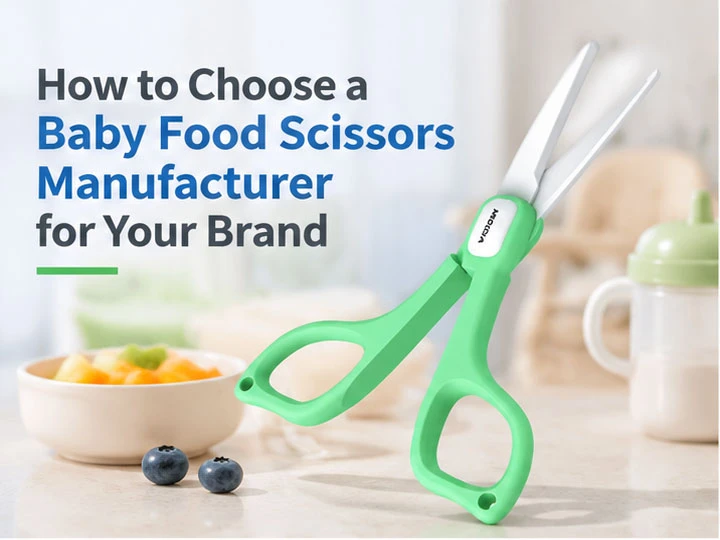
Finding the right baby food scissors manufacturer is an important decision for brands, retailers, distributors, and importers looking to enter or expand within the baby feeding accessories market. While many suppliers may offer similar-looking products, the actual differences often lie in material selection, blade manufacturing, product construction, quality control, and the ability to maintain consistent quality during mass production.
Baby food scissors are not simply smaller versions of ordinary household scissors. They are designed for preparing food for babies and young children, which means buyers need to consider more than appearance and cutting performance. The materials, blade structure, protective components, product durability, and supporting test documentation all deserve careful attention.
This becomes particularly important when sourcing ceramic baby food scissors. Zirconia ceramic offers different material characteristics from conventional stainless steel, but producing a consistent ceramic cutting edge requires appropriate material knowledge and processing control. A supplier that can assemble a finished product may not necessarily have the experience needed to manage ceramic blade quality.
At MIDDIA, we have experience in ceramic product manufacturing and understand how material selection, blade processing, product assembly, and inspection work together. We believe that choosing a manufacturing partner should begin with understanding how a product is made, rather than comparing quotations alone.
In this guide, we share the key factors that we recommend buyers evaluate when selecting a baby food scissors factory, from ceramic blade manufacturing and product testing to OEM/ODM customization, MOQ, and long-term supply reliability.
1. Understand the Difference Between a Manufacturer and a Trading Company
One of the first questions buyers should consider is whether they need to work directly with a manufacturer or purchase through a trading company. Both options can be suitable, depending on the project. However, understanding the difference helps buyers know who is responsible for production, quality control, and problem-solving.
What Does a Baby Food Scissors Manufacturer Actually Do?
A baby food scissors manufacturer is responsible for producing or coordinating the production of the finished product. Depending on its factory setup, manufacturing capabilities may include several processes:
Product development: Reviewing product requirements, dimensions, structural details, and functional expectations.
Material selection: Selecting suitable materials for ceramic blades, handles, protective covers, and other components.
Component manufacturing: Producing or sourcing the individual components required for assembly.
Blade processing: Managing ceramic blade forming, sintering, grinding, edge finishing, or working with qualified specialist suppliers.
Product assembly: Combining the blade, handle, protective cover, and other structural components.
Quality inspection: Checking appearance, dimensions, assembly, functionality, and other agreed specifications.
Packaging and customization: Preparing branded packaging, labels, and product presentation according to customer requirements.
It is worth remembering that not every manufacturer performs every process in-house. Some factories specialize in product assembly and quality management while relying on qualified partners for particular components or processing stages. This is not necessarily a disadvantage. What matters is whether the manufacturer understands the processes, controls the specifications, and takes responsibility for the final product.
How Is a Trading Company Different?
A trading company generally focuses on sourcing products from different factories, coordinating orders, communicating with suppliers, and arranging export services. For buyers who need several unrelated product categories or relatively small quantities, this arrangement can be convenient.
However, a trading company may have less direct control over manufacturing schedules, production changes, material selection, and technical quality issues. When a problem occurs with a ceramic blade or an assembled component, the trading company may need to communicate with another factory before providing an answer.
Neither business model automatically guarantees better quality. A well-managed trading company can provide good sourcing services, while a manufacturer without effective quality management can still deliver inconsistent products.
Questions to Ask Before Identifying a Factory
Before deciding whether a supplier is a suitable baby scissors manufacturer, ask a few practical questions:
Which production processes are completed in your own facility?
Do you have experience with zirconia ceramic cutting products?
Who controls ceramic blade specifications and processing quality?
Can you provide actual production and inspection photographs?
Who is responsible for final product inspection?
Can you maintain product specifications between repeat orders?
At MIDDIA, we believe that transparency about manufacturing responsibilities is important. Buyers should understand which processes a supplier manages directly and which processes involve external partners. This gives both sides a clearer understanding of production responsibilities before an order is placed.
2. Evaluate the Manufacturer's Ceramic Blade Production and Processing Capabilities
For buyers sourcing ceramic baby food scissors, blade manufacturing and processing experience deserves particular attention. A ceramic blade is not simply a component that can be evaluated by its color or appearance. Its material properties and processing history influence the dimensions, surface finish, edge consistency, and overall performance of the finished product.
Understanding Zirconia Ceramic Blade Materials
Zirconia, also known as zirconium dioxide (ZrO₂), is an advanced ceramic material used in various cutting applications. It is valued for its hardness, wear resistance, and resistance to corrosion under many everyday conditions.
Compared with conventional stainless steel blades, zirconia ceramic has several distinctive characteristics:
Hardness: Zirconia ceramic is a hard material that can maintain its cutting edge under appropriate operating conditions.
Wear resistance: Its material characteristics can help reduce edge wear during normal use.
Corrosion resistance: Ceramic does not rust in the same way as conventional metal blades.
Material stability: Zirconia ceramic has good chemical stability in many ordinary food preparation environments.
Different maintenance requirements: Ceramic blades do not require the same rust-prevention measures as steel blades, although proper cleaning, handling, and storage remain important.
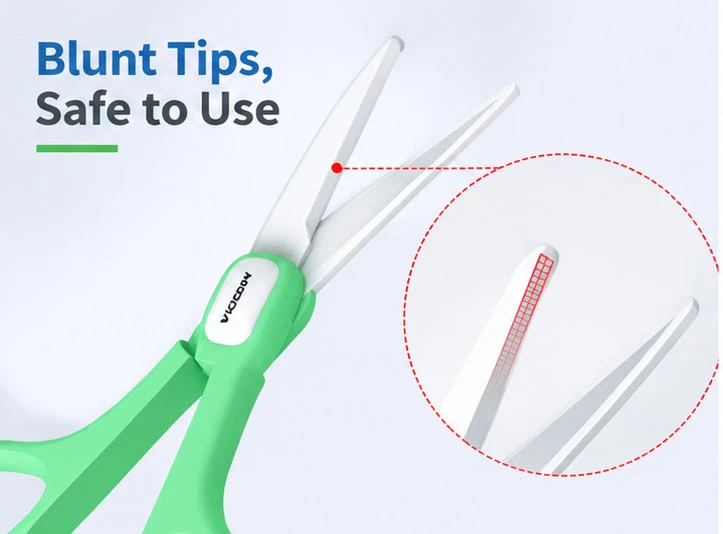
However, ceramic is also a relatively brittle material compared with many metals. It can chip or fracture if subjected to inappropriate impact, excessive force, or unsuitable handling. This is why ceramic blade design, processing quality, and product protection should be considered together.
Why Ceramic Blade Processing Matters
The production of a zirconia ceramic blade involves several important manufacturing stages. Understanding these stages helps buyers distinguish a supplier with genuine ceramic product experience from one that only purchases finished components and assembles them.
1. Raw Material Preparation
The process begins with zirconia ceramic powder. Material composition, powder characteristics, and preparation conditions influence the properties of the ceramic body after processing. Manufacturers should have a clear understanding of the material specifications used in their products.
2. Molding and Forming
The prepared material is shaped into the required blade form. The forming process needs to account for the intended dimensions and the characteristics of the material during subsequent processing.
3. Sintering
Sintering involves heating the formed ceramic material under controlled conditions to develop its final structure. Temperature, time, and process consistency can influence the finished ceramic component. Inconsistent processing may result in dimensional variation or other quality issues.
4. Precision Grinding
After sintering, ceramic components may require grinding to achieve the specified dimensions and geometry. This stage is particularly important for cutting products because the blade profile and edge geometry influence the final product's performance.
5. Edge Finishing and Inspection
The blade is checked for dimensional accuracy, surface condition, visible defects, and edge consistency. Inspection requirements should be established according to the product design and intended application.
What Should Buyers Check When Evaluating Ceramic Blade Quality?
When evaluating a ceramic blade manufacturer or supplier, buyers should pay attention to several details:
Are the blade dimensions consistent with the approved specifications?
Are there visible cracks, chips, or other surface defects?
Is the edge finish consistent between samples?
Are the blade surfaces properly finished?
Does the blade fit correctly within the product structure?
Can the supplier explain how ceramic components are inspected?
Are blade specifications maintained between production batches?
In our experience, ceramic blade quality is not determined by material selection alone. Forming, sintering, grinding, and final inspection all contribute to the consistency of the finished component. Buyers should therefore look for manufacturing knowledge and documented quality controls, not simply a supplier that advertises ceramic blades.
3. Examine Product Structure and Manufacturing Quality Control
A good ceramic blade is only one part of a reliable baby food scissors product. The complete structure also matters. A pair of scissors must combine the blade, handle, connection points, and protective components into a product that functions as intended.
Look Beyond the Ceramic Blade
Depending on the design, baby food scissors may include several main components:
Ceramic cutting blades: The primary cutting components, which should meet the agreed material and dimensional specifications.
Handle: The part held by the user. Its shape, surface finish, and construction influence handling comfort.
Blade connection: The connection between the blades and handle must be properly assembled and controlled.
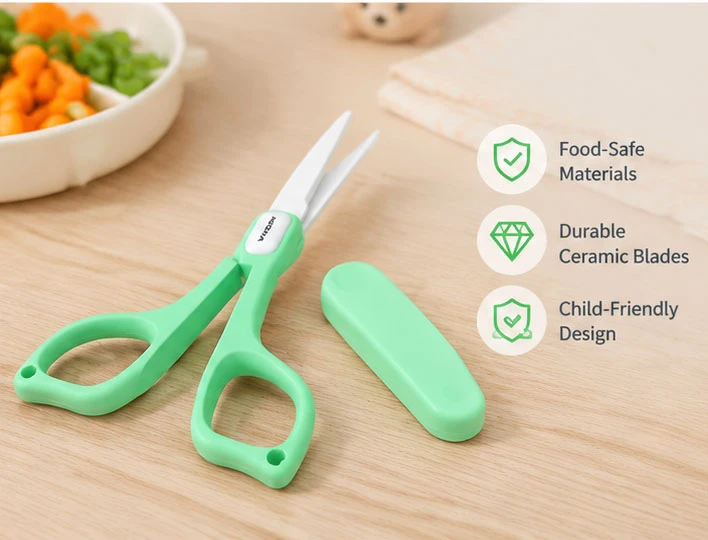
Protective cover or sheath: A component designed to cover the blades during storage and handling.
Safety lock, where applicable: A locking feature that helps keep the scissors closed when not in use.
Different products may use different structures. Some models emphasize compact dimensions and portability, while others include additional protective or locking components. Buyers should evaluate these differences according to their target market and intended product positioning.
Important Product Quality Checkpoints
When we evaluate a finished ceramic cutting product, we do not consider the blade in isolation. The interaction between different components is equally important.
| Inspection Area | What Buyers Should Check |
|---|---|
| Blade alignment | Whether the blades are properly aligned and function consistently. |
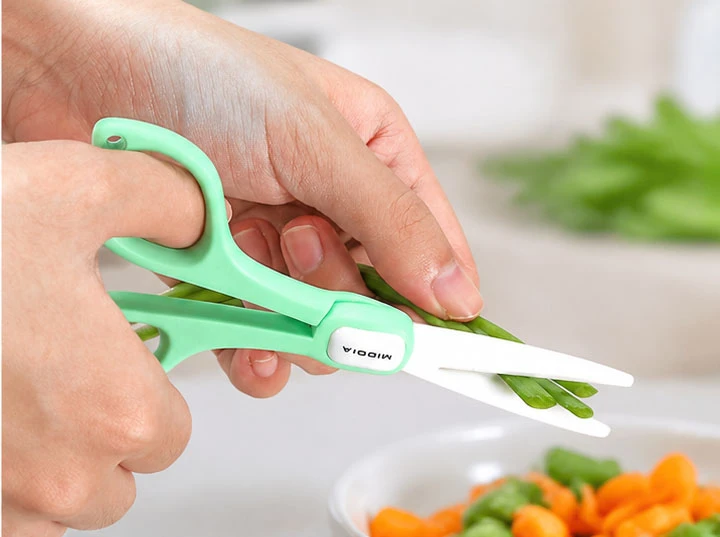
| Cutting performance | Whether the scissors cut the intended food textures under normal operating conditions. |
| Handle structure | Whether the handle is stable and comfortable to operate. |
| Blade connection | Whether the blade assembly is secure and meets the product specifications. |
| Protective cover | Whether the cover fits correctly and provides the intended blade protection. |
| Safety lock | Whether the locking mechanism operates consistently, where included. |
| Appearance | Whether there are visible cracks, burrs, scratches, or other defects. |
Why Consistent Assembly Matters for Baby Feeding Accessories
One issue that buyers sometimes overlook is the difference between a good sample and consistent mass production. A supplier may provide an attractive sample, but that alone does not demonstrate that every production batch will meet the same specifications.
Assembly quality depends on component compatibility, dimensional control, assembly procedures, and inspection. Even small differences in component dimensions can affect the way a product fits together.
We recommend asking manufacturers how they inspect incoming components, how assembly defects are identified, and what procedures they follow when a product does not meet the agreed requirements.
For baby feeding accessories, the goal should be a consistent finished product rather than a sample that looks good only during the initial evaluation.
4. Check Raw Material Quality and Supply Chain Reliability
Manufacturing quality starts before the first component is assembled. The materials used in ceramic baby food scissors influence product performance, appearance, durability, and suitability for the intended application.
Verify the Main Materials Used in Baby Food Scissors
Buyers should understand the materials used in each major component rather than relying on a general description such as premium materials or food-safe materials.
Zirconia ceramic: Used for the cutting blades. Buyers should confirm the material specifications and the manufacturer's quality control procedures.
Handle materials: Plastic materials should be selected according to the required product structure, mechanical properties, appearance, and intended use.
Protective cover materials: These should be suitable for the product design and should fit the corresponding blade structure.
Packaging materials: Packaging should provide suitable product protection during storage, transportation, and retail distribution.
When a product is intended for food preparation, buyers should also pay attention to which components may contact food during normal use. Material documentation and relevant testing should correspond to the actual product configuration.
Ask How Materials Are Selected and Controlled
A reliable baby food scissors factory should be able to explain how materials are approved and inspected. Useful questions include:
Are material specifications documented?
Are suppliers evaluated before materials are accepted?
Are incoming components inspected?
Can material batches be identified and traced?
How are changes in material suppliers or specifications managed?
These questions are particularly important for repeat orders. If a manufacturer changes a material or component supplier without proper evaluation, the finished product may differ from the sample previously approved by the buyer.
Evaluate Long-Term Supply Stability
Supply chain reliability is not only about whether a factory can complete the first order. Brands and distributors need to know whether the manufacturer can support future replenishment orders without unnecessary changes in product specifications.
Consider the availability of important components, raw material lead times, supplier management, production planning, and alternative sourcing arrangements. A manufacturer should also have a clear procedure for evaluating any proposed material or component changes before they affect mass production.
At MIDDIA, we consider material consistency an important part of ceramic product manufacturing. Buyers should be able to understand what materials are used, how they are controlled, and how changes are handled throughout the product's supply cycle.
5. Review Product Testing, Safety Documentation, and Compliance Requirements
Product testing and compliance documentation are important parts of supplier evaluation, especially when sourcing products for baby feeding and food preparation applications. However, buyers should understand what each test or document actually demonstrates.
A manufacturer's statement that a product is tested or certified is not enough by itself. The report should identify the relevant product, materials, testing method, and applicable requirements.
Why Product Testing Matters for Baby Food Scissors
Testing helps buyers evaluate specific product characteristics under defined conditions. Depending on the product and its intended market, relevant evaluations may include:
Structural integrity and durability.
Performance of protective components.
Material suitability for intended food-contact applications.
Mechanical performance of the assembled product.
Appearance and dimensional consistency.
Different tests answer different questions. A mechanical durability test does not automatically establish food-contact compliance, and a material migration test does not demonstrate that a product can withstand every type of impact.
For this reason, we recommend evaluating test reports individually rather than treating a collection of certificates as proof of every possible product characteristic.
Understand SGS 1-Meter Drop Test Results
Drop testing is one way to evaluate how a product responds to a defined impact condition. For ceramic baby food scissors, this is particularly relevant because ceramic materials are hard but can be brittle under certain impact conditions.
MIDDIA's baby food scissors have undergone SGS 1-meter drop testing. This provides buyers with product-specific test evidence to review when evaluating the durability of the tested product configuration.
When reviewing a drop test report, buyers should pay attention to several details:
Tested product: Confirm the exact model and configuration included in the report.
Drop height: Verify that the test was conducted at the stated 1-meter height.
Test conditions: Review the test method, impact surfaces, orientations, and other specified conditions.
Inspection criteria: Understand which parts of the product were examined after testing.
Test results: Check the actual findings and whether the product met the specified acceptance criteria.
It is also important to understand the limitations of a drop test. A product passing a defined drop test does not mean it is unbreakable or that it can withstand every possible impact during use. The test result should be interpreted within the conditions and scope of the actual report.
For buyers, the most useful approach is to request the original SGS documentation and confirm that it corresponds to the model being considered for purchase.
What Do FDA and LFGB Mean for Baby Food Scissors?
FDA-related requirements and LFGB testing documentation are frequently mentioned when buyers source food preparation products. Both deserve attention, but they should not be treated as interchangeable product certifications.
FDA-related requirements
In the United States, the FDA regulates food-contact substances and materials under applicable requirements. Depending on the material and intended conditions of use, buyers may need to review relevant regulatory provisions, supplier declarations, and supporting test documentation.
When evaluating a baby food scissors supplier, ask which components are covered by the FDA-related documentation, what material requirements are being addressed, and whether the intended use conditions are relevant to the product.
It is important to understand that FDA compliance is not a single blanket certification that automatically applies to every finished baby food scissors product. A general statement that a product is FDA approved should not replace specific supporting documentation.
LFGB-related requirements
LFGB refers to Germany's Food and Feed Code. It forms part of the regulatory framework relevant to food-contact materials in Germany. Depending on the materials and intended use, relevant testing may include migration testing and other evaluations under applicable requirements.
Buyers should check which materials were tested, which test methods were used, and whether the results apply to the components that may contact food during normal use.
LFGB testing documentation can be useful when evaluating products for European markets, but buyers should also consider the applicable EU and national requirements for the actual product.
Questions Buyers Should Ask About Test Reports
Before accepting a supplier's compliance claims, ask:
Which exact product model was tested?
Were the tested materials the same as those used in current production?
Which testing standards and methods were applied?
What were the actual results?
Does the report cover the relevant food-contact components?
Has the product configuration changed since testing?
Can the manufacturer provide the original report for review?
At MIDDIA, we believe that product claims should be supported by verifiable documentation. Our baby food scissors have SGS 1-meter drop test experience, and we have FDA- and LFGB-related documentation for product evaluation. We encourage buyers to review the actual reports and confirm their scope, tested materials, and applicable requirements before making a purchasing decision.
6. Evaluate OEM and ODM Customization Capabilities
For baby product brands, the ability to customize a product can be just as important as its basic manufacturing quality. A retailer may need private-label packaging, while an established brand may want a particular color scheme or product configuration that matches its existing product range.
A suitable baby food scissors manufacturer should be able to explain which customization options are available and what production requirements are involved.
OEM Services for Baby Product Brands
OEM generally refers to manufacturing products according to a buyer's requirements, specifications, or branding. For ceramic baby food scissors, common OEM requests include:
Custom brand logos on suitable product surfaces.
Private-label packaging.
Custom packaging artwork and printed information.
Brand-specific product presentation.
Customized labels and retail packaging configurations.
Before starting an OEM project, buyers should confirm the available logo application methods, artwork requirements, packaging specifications, and minimum order quantities.
ODM Services and Product Development Support
ODM involves a different level of product development support. Rather than simply applying a customer's logo to an existing item, ODM projects may involve adjustments to the product design or configuration.
Depending on the manufacturer's capabilities and existing tooling, possible development areas include:
Handle design and color options.
Protective cover configurations.
Product dimensions and structural details.
Selected material and component options.
New product variations based on market requirements.
Buyers should ask whether proposed changes can be made using existing tooling or require new molds and development work. This can have a significant effect on project cost and lead time.
Ask About Customization MOQ and Development Costs
Customization usually involves additional preparation compared with ordering standard products. Printing, color management, packaging materials, and production setup can all influence the minimum order quantity.
At MIDDIA, our current customization arrangements include:
Custom logo: MOQ of 2,000 units.
Custom packaging and color: MOQ of 3,000 units.
These quantities should be confirmed for the specific product model and customization requirements before an order is placed. Different packaging structures, printing methods, and development requests may involve different cost considerations.
We understand that every brand has its own positioning and retail strategy. Our aim is to help buyers explore practical customization options that fit their product portfolios without introducing unnecessary complexity into the manufacturing process.
7. Compare MOQ, Sample Availability, Lead Time, and After-Sales Support
Once a supplier's manufacturing and quality capabilities have been evaluated, the next step is to understand whether its commercial arrangements fit your business. Even a technically capable factory may not be the right partner if its MOQ, sampling process, or production schedule does not match your purchasing plan.
Understand the Manufacturer's MOQ Policy
MOQ, or minimum order quantity, can vary depending on the product and customization level. Buyers should not assume that the MOQ for a standard product will be the same as the MOQ for a fully customized version.
Ask the manufacturer to clarify:
Standard product MOQ.
Custom logo MOQ.
Custom packaging MOQ.
Custom color MOQ.
Repeat-order MOQ.
It is also useful to ask whether different product models or colors can be combined within one order. This may help distributors and retailers manage inventory when testing a new product category.
Request Samples Before Placing Bulk Orders
Samples allow buyers to examine a product directly instead of relying entirely on photographs, specifications, or supplier descriptions.
When evaluating ceramic baby food scissors samples, we recommend checking:
Blade appearance and surface finish.
Cutting performance with the intended food textures.
Handle comfort and operating stability.
Blade alignment and assembly.
Protective cover fit.
Safety lock operation, if included.
Packaging appearance and product presentation.
Buyers should also confirm whether the sample uses the same materials, components, and specifications intended for mass production. If the sample is only a preliminary development version, the differences should be documented before approval.
Confirm Production Lead Time and Delivery Planning
Production lead time is influenced by several factors, including order quantity, material availability, customization requirements, packaging preparation, and factory scheduling.
Rather than asking only how many days production will take, buyers should request a breakdown of the main stages:
Sample preparation and evaluation.
Artwork and packaging approval.
Material and component preparation.
Mass production.
Final inspection and packaging.
Shipping coordination.
A clear production schedule helps importers and distributors coordinate inventory, retail launches, and replenishment orders. It also makes it easier to identify potential delays before they affect the delivery date.
Evaluate After-Sales and Problem-Solving Capabilities
Supplier evaluation should not end when the goods leave the factory. Buyers need to understand how the manufacturer handles product complaints, quality issues, and repeat-order differences.
Ask whether the supplier has procedures for:
Recording and investigating product complaints.
Identifying the cause of quality defects.
Implementing corrective and preventive actions.
Evaluating replacement or compensation requests.
Maintaining records for future production batches.
We believe that a manufacturing partner should be able to discuss problems openly and work toward practical solutions. This is especially important for brands that plan to maintain the same product over multiple purchasing cycles.
8. How to Evaluate a Baby Food Scissors Manufacturer for Long-Term Cooperation
A good first order is useful, but it does not necessarily prove that a supplier is suitable for long-term cooperation. Brands, importers, and distributors should consider whether the manufacturer can support the product as the business grows.
Look at More Than the First Order
Long-term supply relationships depend on several factors working together:
Stable specifications: Product dimensions, materials, and approved configurations should remain consistent unless changes are agreed upon.
Repeat-order quality: Future production should follow the approved sample and quality requirements.
Reliable communication: The supplier should provide clear updates about production progress and potential issues.
Production planning: The manufacturer should be able to coordinate material preparation and production schedules.
Documentation: Relevant product specifications, inspection records, and test documents should be available for review.
Evaluate the Manufacturer's Ability to Grow with Your Brand
A product that works for a small initial launch may need additional variations as the brand expands. For example, a retailer may initially introduce one ceramic baby food scissors model and later consider different colors, packaging styles, or product configurations.
When assessing a potential partner, consider whether the manufacturer can support future development requests, such as:
Different product sizes.
New color combinations.
Additional protective accessories.
Customized retail packaging.
New product variations for different sales channels.
It is not necessary for a manufacturer to offer every possible customization. What matters is whether it can clearly explain its capabilities, limitations, development process, and expected costs.
Build a Long-Term Supplier Relationship
We believe a reliable manufacturing relationship is built through clear specifications, sample approval, consistent quality requirements, and transparent communication.
For buyers, it is helpful to establish an agreed product specification before mass production. This document can include dimensions, materials, colors, packaging requirements, inspection criteria, and any applicable testing expectations.
When both parties understand these requirements, it becomes easier to manage repeat orders and address differences before they develop into larger problems.
9. Baby Food Scissors Manufacturer Evaluation Checklist: 10 Things Buyers Should Verify
After comparing different suppliers, it is useful to organize the information into a consistent evaluation process. The following checklist can help baby product brands, retailers, importers, and purchasing managers compare potential manufacturing partners more objectively.
| No. | Evaluation Criteria | What Buyers Should Verify |
|---|---|---|
| 1 | Manufacturing Capability | Does the supplier clearly explain its manufacturing processes and production responsibilities? |
| 2 | Ceramic Blade Expertise | Can it demonstrate knowledge of zirconia ceramic materials, blade processing, and quality inspection? |
| 3 | Product Structure | Are the blades, handles, connections, protective covers, and locking components properly controlled? |
| 4 | Raw Material Control | Are material specifications, supplier qualifications, and incoming inspections documented? |
| 5 | Quality Management | Are inspection procedures established for samples, components, and mass production? |
| 6 | Product Testing | Can the supplier provide relevant SGS and other product test reports? |
| 7 | Compliance Documentation | Are FDA-related and LFGB documents relevant to the actual materials, product configuration, and target market? |
| 8 | OEM/ODM Capabilities | Can the manufacturer support the required logo, color, packaging, and product customization? |
| 9 | MOQ and Delivery | Are minimum order quantities, sample arrangements, lead times, and production capacity clearly communicated? |
| 10 | Long-Term Support | Can the supplier maintain repeat-order consistency, traceability, and effective problem resolution? |
How to Use This Checklist When Comparing Suppliers
We recommend using these ten criteria as a practical comparison tool rather than treating them as a formal industry certification standard.
For example, buyers can assign an internal score from 1 to 5 for each criterion:
1 – Insufficient: The supplier cannot provide clear information or supporting evidence.
2 – Limited: Some capabilities are available, but important details remain unclear.
3 – Acceptable: The supplier meets basic expectations and provides relevant information.
4 – Strong: The supplier demonstrates good manufacturing control and supporting documentation.
5 – Well Verified: The supplier provides clear evidence of its capabilities and consistent quality management.
Not every criterion needs to carry the same importance for every project. For ceramic baby food scissors, we suggest giving particular attention to ceramic blade processing, product structure, material documentation, and product testing.
Before placing a large order, buyers should also compare physical samples and confirm that the approved product specifications match the planned mass production version. A supplier's ability to provide convincing explanations is useful, but actual evidence and sample evaluation should carry more weight in the final decision.
10. Why Consider MIDDIA as Your Baby Food Scissors Manufacturing Partner?
After reviewing the main criteria for selecting a manufacturer, buyers may want to understand how a potential supplier's capabilities relate to their own sourcing requirements.
At MIDDIA, our background in ceramic product manufacturing gives us experience with zirconia ceramic materials and their processing requirements. We understand that a finished ceramic cutting product involves more than choosing a blade material. Blade processing, component compatibility, assembly, and final inspection all contribute to the finished product.
Ceramic Product Manufacturing Experience
Our experience in ceramic products provides a foundation for understanding the material characteristics and manufacturing considerations involved in ceramic cutting tools. We pay attention to the relationship between material quality, blade dimensions, processing, and finished product requirements.
For buyers interested in ceramic baby food scissors, this experience is relevant when discussing product specifications, sample evaluation, and potential customization options.
Baby Food Scissors Product Options
MIDDIA offers ceramic baby food scissors in different product configurations, including selected 2-inch and 2.5-inch models. Depending on the model, product features may include different protective cover designs and locking structures.
These options give retailers, distributors, and brands a starting point when evaluating products for different market segments. Buyers can review the existing collection to compare product dimensions, appearance, and available configurations before discussing their requirements.
Product Testing and Customization Support
Our baby food scissors have undergone SGS 1-meter drop testing. We also have FDA- and LFGB-related documentation for product evaluation. Buyers are welcome to review the actual supporting reports and confirm their applicability to the selected model and intended market.
For brands developing their own product lines, MIDDIA also provides customization options:
Custom logo application, with a current MOQ of 2,000 units.
Custom packaging and color options, with a current MOQ of 3,000 units.
Product selection and customization discussions based on the buyer's requirements.
We understand that different customers have different purchasing priorities. A distributor may focus on product availability and repeat-order consistency, while a baby product brand may place greater emphasis on private labeling, packaging, and product presentation.
Our approach is to understand the project first, clarify the product requirements, and then discuss suitable product options and manufacturing arrangements.
Conclusion: Choose a Manufacturer That Can Support Your Brand Beyond the First Order
Choosing a reliable baby food scissors manufacturer requires more than comparing product photographs and unit prices. Buyers should evaluate ceramic blade processing, product construction, raw material control, quality inspection, testing documentation, and OEM/ODM capabilities.
For ceramic baby food scissors in particular, it is important to understand how zirconia blades are manufactured and how their quality is controlled throughout production. Reviewing actual test reports, checking samples, and confirming the scope of compliance documentation can also help reduce sourcing risks.
Most importantly, consider whether the supplier can maintain product consistency and support your business as your product line grows. A manufacturing partner should be able to provide clear communication, practical customization options, and reliable support beyond the initial order.
If you are developing a new baby feeding accessories line, sourcing ceramic baby food scissors for retail, or evaluating OEM manufacturing partners, MIDDIA welcomes the opportunity to discuss your project.
Frequently Asked Questions About Baby Food Scissors Manufacturers
1. What should I look for in a baby food scissors manufacturer?
Look for a manufacturer with relevant product experience, clear material specifications, reliable quality control, and appropriate product testing documentation. For ceramic baby food scissors, pay particular attention to zirconia blade processing, blade-to-handle assembly, and finished product inspection. OEM/ODM capabilities, sample availability, MOQ, and repeat-order consistency are also important when selecting a long-term supplier.
2. What is the difference between a baby scissors manufacturer and a trading company?
A manufacturer is responsible for producing or managing the production of the finished product, while a trading company generally focuses on sourcing, supplier coordination, and export services. A manufacturer may offer more direct communication about production and quality requirements, while a trading company can be convenient for multi-category sourcing. Buyers should evaluate actual manufacturing responsibilities rather than relying on company labels alone.
3. Why is ceramic blade manufacturing experience important?
Zirconia ceramic blades require appropriate material preparation, forming, sintering, grinding, and inspection. These processes influence blade dimensions, surface quality, and consistency. A supplier with ceramic manufacturing experience is generally better positioned to explain these processes and identify potential quality issues. Buyers should ask for relevant manufacturing information and inspect actual product samples before placing bulk orders.
4. What certifications or test reports should a baby food scissors supplier provide?
Relevant documents depend on the product materials, intended use, and target market. Buyers may need to review food-contact material documentation, FDA-related compliance information, LFGB testing reports, and mechanical test results such as an SGS drop test. Always confirm the tested product, materials, methods, and report scope. No single test report automatically demonstrates compliance with every requirement in every market.
5. Can baby food scissors manufacturers provide OEM and ODM services?
Many manufacturers offer OEM services such as custom logos, private-label packaging, and branded product presentation. ODM services may include selected changes to product colors, handles, protective covers, dimensions, or structural configurations. The available options depend on existing tooling and manufacturing capabilities. Buyers should confirm customization feasibility, development costs, artwork requirements, and MOQ before starting a project.
6. What MOQ should I expect when ordering custom baby food scissors?
MOQ varies according to the manufacturer, product model, and customization requirements. Standard products may have different minimum quantities from customized products. For example, MIDDIA's current arrangements include a 2,000-unit MOQ for custom logos and a 3,000-unit MOQ for custom packaging and color. Buyers should confirm the current MOQ for their specific product and order configuration.